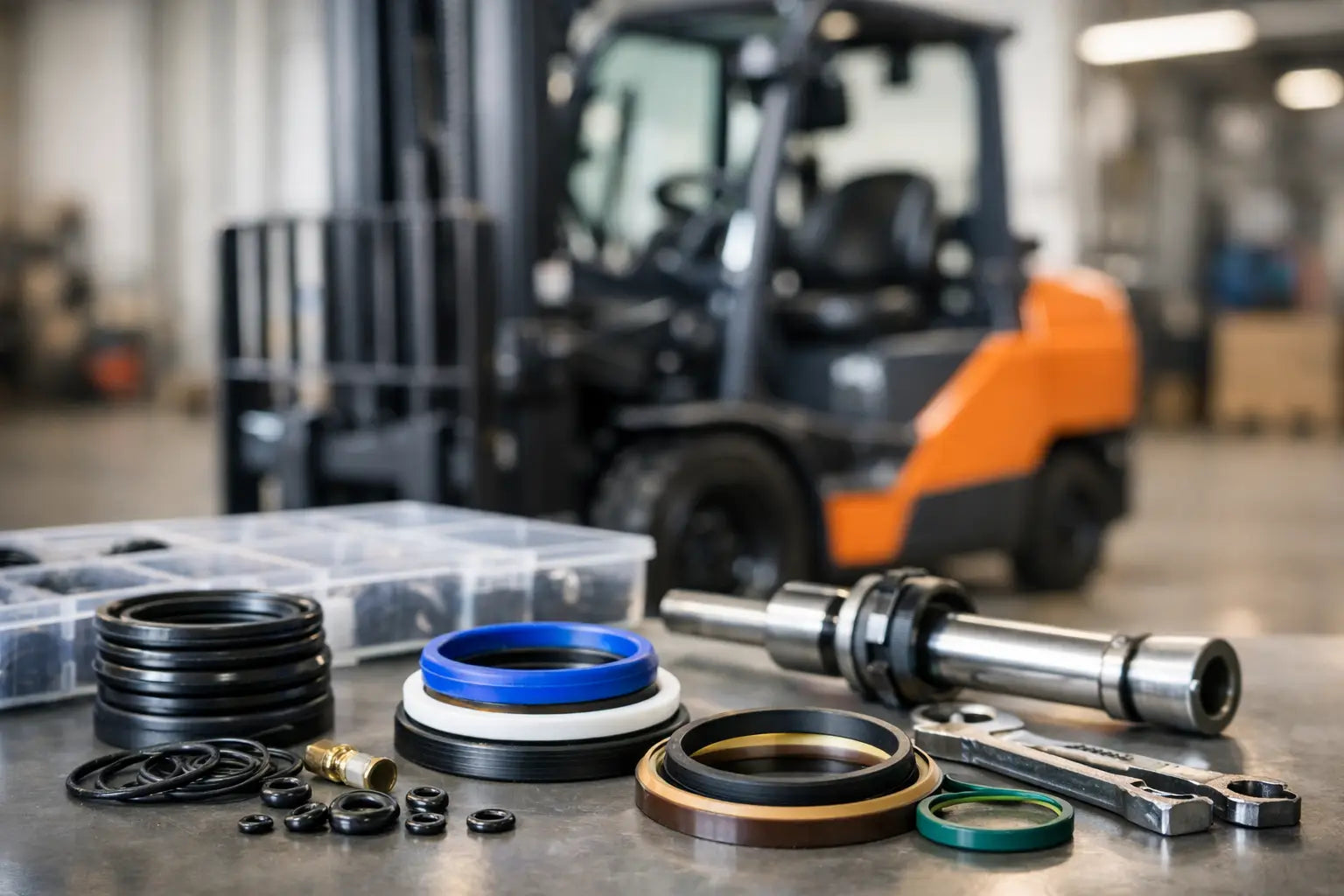
A forklift that creeps down with a raised load, leaves hydraulic oil at the mast, or loses steering response does not need a generic “seal assortment.” It needs the correct repair kit for the exact cylinder and application. The best forklift seal kits are the ones that match the machine, cylinder position, seal dimensions, operating conditions, and required dispatch date - not simply the lowest-priced kits on a parts list.
For fleet managers, repair shops, and material-handling contractors, this distinction affects more than the repair invoice. Incorrect seals can mean a repeat teardown, damaged rod surfaces, ongoing oil loss, and another unit out of service. Accurate fitment is the fastest route back to dependable lifting, tilting, and steering performance.
What Makes the Best Forklift Seal Kits?
A forklift seal kit is usually sold for one hydraulic cylinder location, such as a lift cylinder, tilt cylinder, steering cylinder, side-shift cylinder, or reach mechanism. The kit may contain a rod seal, piston seal, wiper, wear rings, O-rings, backup rings, and static seals. The exact contents vary by cylinder design, manufacturer, and revision.
That is why a kit identified only as “for Toyota forklift” or “for 3-ton forklift” is not enough for procurement. A single truck series may use different mast options, cylinder bore sizes, rod diameters, and supplier-built hydraulic cylinders. Even machines with the same model designation can have production changes that alter the seal stack.
The best kits provide a clear path to verification. Look for the forklift make and model where available, then confirm the cylinder application, OEM part number, cylinder number, and dimensions. A listing with a precise reference number or dimensional specification is far more useful than a broad compatibility claim.
Quality also matters, but it should be judged by application rather than label alone. A correctly specified polyurethane rod seal and compatible NBR O-ring set can be the right value choice for a standard warehouse forklift. A high-temperature application, aggressive fluid environment, or heavily cycled outdoor fleet may justify different materials or a premium branded seal profile. The goal is not to over-specify every repair. It is to install seals that suit the working conditions and hold up through the expected service interval.
Start With the Cylinder, Not the Truck Name
Forklift owners often begin with the truck model because it is visible on the data plate. For seal-kit ordering, the hydraulic cylinder is usually the more reliable starting point. Identify whether the repair concerns the lift, tilt, steering, or attachment circuit. Then locate the cylinder part number, manufacturer label, or stamped code if available.
For mast cylinders, confirm whether the unit is a primary lift cylinder, free-lift cylinder, or a secondary stage cylinder. On a tilt repair, check whether the forklift uses one or two tilt cylinders and whether left- and right-side units share the same internal configuration. A steering cylinder may look simple, but rod-end and cap-end seal arrangements can differ by axle design.
If the cylinder tag is missing, measure only after disassembly and cleaning. The key dimensions generally include cylinder bore, rod diameter, piston width, gland dimensions, and seal groove sizes. Measuring the old seal alone can be misleading because worn elastomer can shrink, swell, or deform. Match the seal cross-section and groove specification wherever possible.
How to Choose a Forklift Seal Kit Without Rework
The purchasing process should reduce uncertainty before the truck is taken apart. Start by collecting every identifier available from the machine and cylinder. This includes forklift brand, model, serial number range, mast type, cylinder location, cylinder part number, and any old kit or seal number. Clear photos of the cylinder tag and removed seals can also help resolve difficult matches.
Next, compare the required kit against the actual failure point. An external oil leak at the rod normally points to the rod seal, wiper, or gland seals. Internal drift may involve the piston seal, wear rings, or cylinder bore condition. Replacing only the visible leaking seal can be a false economy when the cylinder is already open and the full kit is available.
Before ordering, verify these practical points:
- The kit is specified for the correct cylinder position and machine configuration.
- Part numbers are cross-checked against the cylinder or equipment documentation.
- Seal materials suit the hydraulic fluid, temperature range, and duty cycle.
- The listing states what is included, especially wipers, wear rings, and backup rings.
- Stock status and dispatch timing support the required repair schedule.
Material Selection Depends on Service Conditions
Most forklift hydraulic repairs operate well with common seal materials, but the material decision should still be deliberate. NBR is widely used for mineral-oil hydraulic systems and provides solid general-purpose performance. Polyurethane is common for rod and piston seals because it offers good wear resistance under normal material-handling loads. PTFE-based seals can be useful in certain low-friction or demanding configurations, typically with an energizer to maintain sealing force.
FKM may be considered where higher temperatures or specific fluid compatibility requirements apply, but it is not automatically the best option for every forklift. It can cost more and may not be necessary in standard indoor warehouse service. Likewise, a very hard seal compound can resist extrusion but may be less forgiving on a scored rod or imperfect bore.
Inspect the fluid condition before fitting any new kit. Dark, contaminated, or milky hydraulic oil can quickly damage fresh seals. If the system has visible contamination, address filtration, fluid replacement, and cylinder cleaning as part of the repair. A new seal kit cannot compensate for abrasive contamination circulating through the hydraulic system.
OEM, Aftermarket, and Branded Seal Kit Options
OEM forklift seal kits offer a direct reference path when the original part number is known. They can be the safest option for newer equipment, unusual mast configurations, or applications where manufacturer documentation is available. The trade-off can be price and lead time, especially for older or imported machines.
Aftermarket kits can provide strong value when they are built to the correct profile, dimensions, and material specification. A quality aftermarket kit is not simply a mixed box of seals that happen to be close in size. It should follow the cylinder’s original sealing arrangement and include the components needed for a complete rebuild.
Recognized industrial seal brands may be preferred where buyers need known material standards, profile consistency, or support for nonstandard dimensional repairs. However, brand alone does not establish fitment. A premium seal with the wrong lip design, cross-section, or tolerance will fail just as surely as a low-grade substitute.
For urgent downtime repairs, availability often decides the best commercial choice. A correctly matched kit that is in stock and ready for fast dispatch can be more valuable than a theoretical OEM option with a long lead time. MXPseal supports this requirement with ready-stock seal kits and replacement sealing components across forklift and heavy-equipment applications, with part-number and dimensional matching as the basis for selection.
Inspect the Cylinder Before Installing New Seals
Seal replacement should not begin and end with opening the gland. Examine the rod for pitting, chrome flaking, corrosion, deep scoring, and bent sections. A sharp defect on the rod can cut a new rod seal during installation. Check the cylinder bore for scoring and measure for excessive wear if internal bypass has been a recurring problem.
Inspect the gland, piston, and seal grooves for burrs or damage. Clean every component thoroughly, but avoid abrasive methods that alter groove edges. Install seals in the correct orientation, use suitable assembly lubricant compatible with the hydraulic fluid, and protect sealing lips when passing threads, ports, or sharp edges.
For lift-cylinder work, follow the forklift manufacturer’s safety procedure. Fully lower and secure the mast, relieve hydraulic pressure, and support components correctly before disconnecting cylinders or hoses. Mast and carriage assemblies carry serious stored-load risks. A correct kit does not make an unsafe repair procedure acceptable.
Keep Accurate Fitment Records for the Next Repair
Once a forklift seal kit has been confirmed and installed successfully, record the kit number, cylinder number, machine serial range, repair date, and any measured dimensions. This turns the next failure from a research task into a straightforward reorder. It also helps maintenance teams identify repeat issues caused by contamination, rod damage, overloaded operation, or a mismatched previous repair.
The right kit is the one that fits the cylinder the first time, arrives when the repair bay needs it, and keeps the forklift working after it goes back into service. Treat the part number and cylinder details as essential maintenance data, not optional ordering notes.