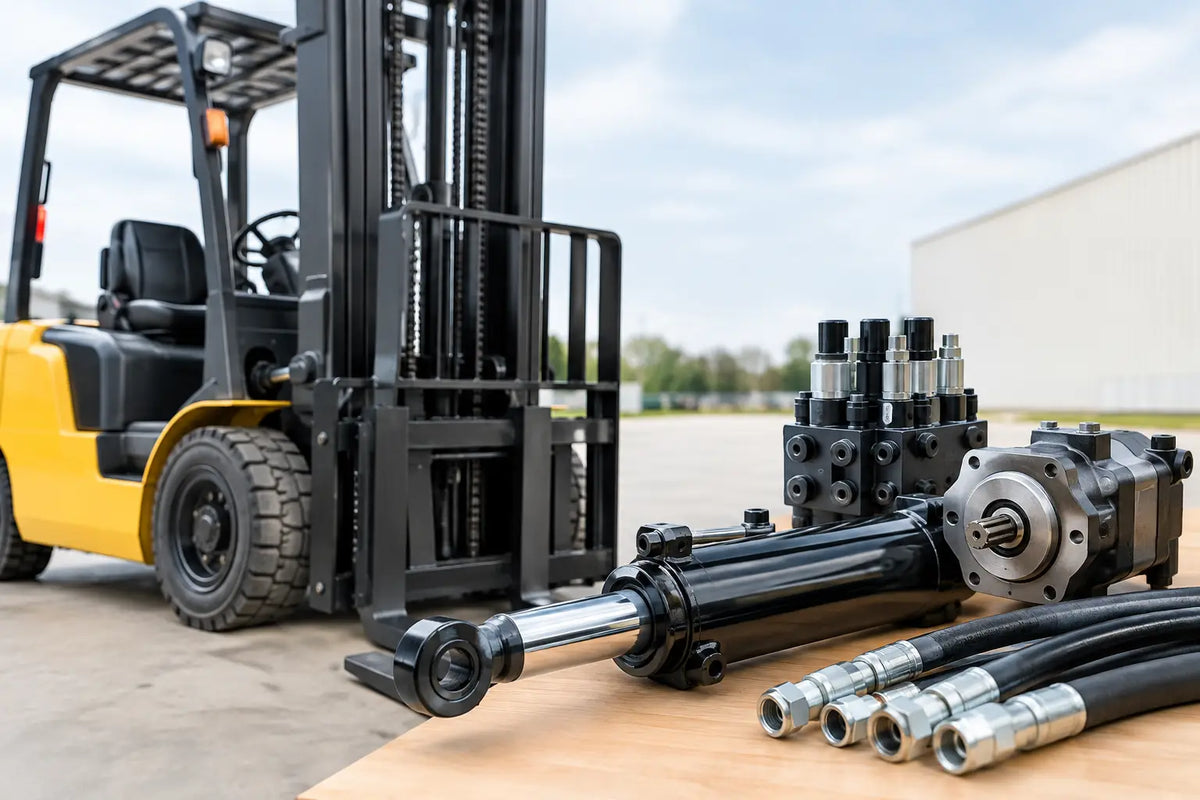
A forklift that raises slowly, drifts down under load, or leaves oil around the mast is not just due for a top-up. Forklift hydraulic components work as one pressure-controlled system, and a small seal failure, restricted hose, or worn valve can quickly become lost lifting capacity, damaged loads, and unplanned downtime. For maintenance teams, the objective is to identify the failed component accurately and return the truck to service without fitting parts twice.
How Forklift Hydraulic Components Work Together
The hydraulic circuit converts engine or electric motor power into controlled lifting and tilting force. Hydraulic oil is drawn from the reservoir by a pump, pressurized, directed through control valves, and sent to the lift, tilt, or side-shift cylinders. The cylinders convert that pressure into linear movement. Return oil then flows back through filtration and into the tank.
This sounds straightforward, but forklifts operate with frequent direction changes, repeated full-stroke cycles, side loads at the mast, and contamination exposure around the carriage. A fault in one area can resemble a fault in another. For example, a mast that will not hold height may have worn lift-cylinder piston seals, but it may also have internal leakage across a control valve spool or a load-holding valve.
Accurate diagnosis saves money because the correct repair may be a cylinder seal kit rather than a complete cylinder, or a suction-side hose and filter service rather than a replacement pump.
Hydraulic Pump and Reservoir
The hydraulic pump supplies flow. Gear pumps are common on internal-combustion forklifts, while electric trucks may use motor-pump assemblies designed for their specific hydraulic demand. A worn pump may cause slow or weak functions across the entire machine, especially when oil is hot. Whine, cavitation, foamy oil, and erratic movement point first toward low fluid level, a blocked suction strainer, an air leak on the inlet side, or incorrect oil viscosity before the pump is condemned.
The reservoir stores oil, allows heat to dissipate, and helps air separate from the fluid. A damaged filler cap breather or neglected filter can introduce contamination that shortens the life of every downstream component.
Control Valves, Relief Valves, and Hoses
The main control valve meters oil to each function. Its spools, springs, seals, and load-check sections must move freely and hold pressure correctly. Relief valves protect the system from excess pressure, while flow-control or priority valves regulate function speed where fitted.
A hose is not a generic replacement item. Pressure rating, inside diameter, fitting type, length, routing, and bend radius all affect service life. A hose that is too short can pull on fittings as the mast moves. One with the wrong bore can restrict flow and create heat. Replace damaged hose assemblies promptly, and inspect adjacent hoses for abrasion from mast channels, chains, or clamps.
Lift Cylinders and Mast Seals
Lift cylinders are among the most frequently serviced forklift hydraulic components. They use several seals with different jobs: rod seals retain pressurized oil, wipers keep dirt off the rod, piston seals separate pressure chambers, and wear rings prevent metal-to-metal contact. Static O-rings or backup rings seal glands and other fixed interfaces.
External oil at the cylinder rod usually indicates a failed rod seal, damaged wiper, scored rod, or worn gland. Internal bypass across a piston seal may produce mast drift without an obvious external leak. Before ordering a kit, verify the truck make and model, cylinder position, OEM part number where available, and actual rod, bore, piston, and seal-groove dimensions. A seal that appears close in size is not a reliable fitment method.
Common Failure Signs and What They Mean
Hydraulic symptoms should be assessed with the load removed, the mast secured, and the manufacturer’s safety procedure followed. Never place hands near a suspected pinhole leak. High-pressure oil injection injuries require immediate medical treatment.
The following signs help narrow the inspection:
- Slow lifting on all functions: Check oil level, filter restriction, pump inlet condition, relief setting, pump wear, and fluid temperature.
- Mast drifts down with the control lever centered: Check lift-cylinder piston seals, control-valve internal leakage, and load-holding components.
- Oil on cylinder rods or floor: Inspect rod seals, wipers, rod surface condition, gland threads, hose fittings, and cylinder-port connections.
- Jerky or noisy operation: Look for aerated oil, suction leaks, low fluid level, contaminated filters, sticking valve spools, or side-loaded cylinder rods.
- One function is weak while others operate normally: Focus on the relevant valve section, hose circuit, cylinder, and attachment circuit rather than the main pump.
Choosing Replacement Parts Without Creating a Repeat Repair
The fastest repair is not always the one with the earliest available part. A low-cost seal of unknown material, a mismatched hose fitting, or a cylinder kit selected by visual appearance can bring the forklift back into the workshop within days. Fitment and material compatibility should come first.
For seals, confirm whether the application requires NBR, polyurethane, FKM, PTFE, or another compound. Standard NBR suits many mineral-oil hydraulic systems, while polyurethane is often selected for high wear resistance in rod and piston sealing applications. Heat, fluid type, pressure, rod speed, and contamination levels determine whether an alternative material is justified.
For a cylinder repair, inspect the hard parts before opening a seal kit. A pitted rod will cut a new rod seal. A scored barrel can bypass oil past a new piston seal. Excessive bushing or bearing clearance can side-load the rod and wear the gland prematurely. If the cylinder tube, rod, or gland is beyond acceptable condition, a seal kit alone is a false economy.
Part identification should be based on the strongest available reference: OEM part number, forklift model and serial range, cylinder manufacturer number, or measured dimensions. When measuring, record the seal profile as well as the ID, OD, and height. A lip seal, U-cup, compact piston seal, and wiper can share similar dimensions while serving entirely different functions.
MXPseal supports this process with machine-specific seal kits, hydraulic seals, oil seals, bearings, and replacement parts identified by equipment application, manufacturer code, and dimensional specification. For urgent repairs, confirming stock status and dispatch timing before stripping down the truck helps keep the job controlled.
Installation Practices That Protect the New Parts
Cleanliness is part of the repair, not an optional final step. Cap open hydraulic lines, clean the outside of the cylinder before disassembly, and keep removed parts organized by location. Dirt introduced during assembly can score a spool or damage a fresh seal immediately.
Use installation tools that will not nick seal lips or stretch profiles beyond their limit. Lubricate seals with compatible clean hydraulic oil unless the seal supplier specifies otherwise. Check rod threads, port edges, and retaining grooves for sharp burrs, then use a protective sleeve or installation cone when the seal must pass over those areas.
After reassembly, bleed air according to the equipment procedure and cycle the function slowly without a load. Check for leaks, abnormal noise, pressure instability, and mast drift before returning the forklift to normal work. Recheck fluid level after the system has filled the repaired cylinder and cooled.
Preventive Work That Reduces Hydraulic Downtime
Most hydraulic failures give warning before they stop a forklift. Add cylinder rods, hose routing, fluid level, fittings, and mast behavior to daily or weekly inspection routines. A clean rod and dry gland are easier to monitor than a cylinder coated in old oil and warehouse dust.
Follow the manufacturer’s fluid and filter intervals, but adjust the schedule when the truck works in dusty yards, cold storage, foundries, recycling areas, or multi-shift service. Severe-duty environments may require more frequent oil analysis and filter changes. Also check that replacement filters meet the required bypass, micron, and flow specifications.
Keep accurate records of cylinder repairs, hose replacements, fluid type, and recurring symptoms by truck serial number. This turns future procurement into a verified part-number order rather than a rushed search after failure. When a forklift’s hydraulic system is treated as a matched circuit instead of a collection of individual leaks, parts selection becomes faster, repairs last longer, and the mast stays where the operator expects it to stay.