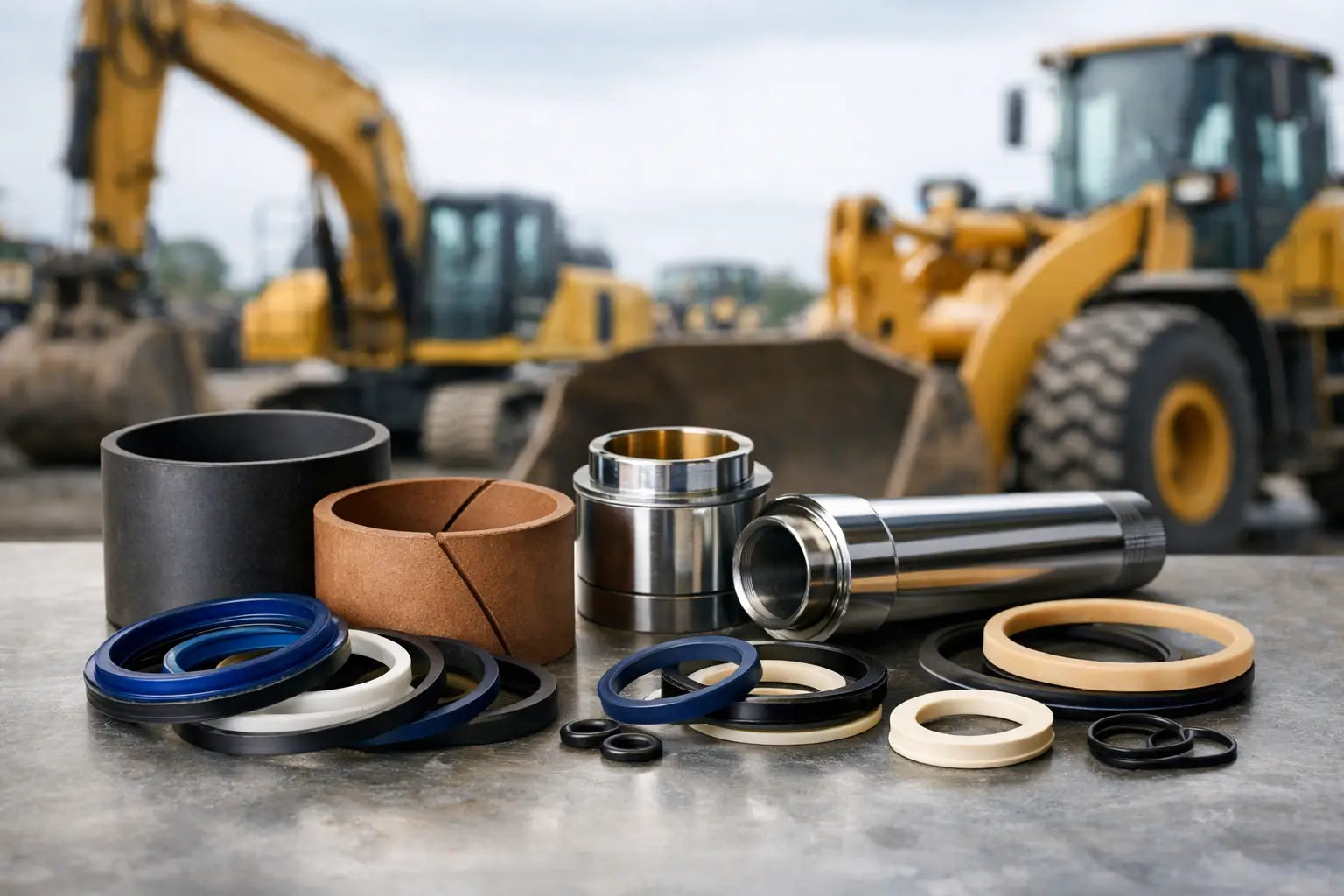
A cylinder kit can match the machine model, cylinder location, and dimensions perfectly yet fail early because the material is wrong for the job. This guide to cylinder seal materials is for repair teams that need to identify the right compound before a boom, bucket, steering, tilt, or lift cylinder goes back into service.
For heavy equipment, seal material selection is not a catalog detail. It directly affects leakage, breakaway friction, rod protection, service intervals, and the risk of an urgent rework. Pressure, hydraulic fluid, contamination, temperature, rod condition, and cylinder speed all matter. There is no single best seal material - there is only the best material for the actual operating conditions.
Guide to cylinder seal materials: start with the seal function
A hydraulic cylinder uses several seal components, and they do not all need the same material. The piston seal holds pressure between cylinder chambers. The rod seal prevents external fluid leakage along the piston rod. The wiper or scraper keeps mud, dust, water, and abrasive debris out of the cylinder. Wear rings guide the piston and rod to prevent metal-to-metal contact.
That distinction matters during kit selection. A polyurethane rod seal may be an excellent choice for a high-pressure excavator cylinder, while an elastomer O-ring with PTFE backup rings may be the right answer for a piston assembly. A wiper needs abrasion resistance and flexibility, but it is not the primary pressure seal.
When ordering a replacement kit, verify the cylinder position as well as the machine model. Boom, arm, bucket, blade, steering, tilt, lift, and outrigger cylinders can use different profiles and materials even on the same machine. Match the OEM part number where available, then confirm rod diameter, bore diameter, groove dimensions, and seal cross section.
NBR: the standard choice for mineral oil hydraulics
Nitrile rubber, commonly called NBR or Buna-N, is widely used in hydraulic sealing because it works well with standard petroleum-based hydraulic oils. It offers good oil resistance, reasonable abrasion resistance, and cost-effective performance for normal equipment service.
NBR is frequently found in O-rings, bonded seals, static seals, and some dynamic seal designs. For a machine operating with conventional hydraulic oil in moderate temperatures, it is often a practical and economical material. It is also easy to source in many standard dimensions.
The limitation is temperature and fluid compatibility. Standard NBR can harden or lose elasticity at higher temperatures, and it is not suitable for every synthetic fluid, chemical, or bio-based oil. If a cylinder operates near heat sources, sees sustained high oil temperatures, or uses nonstandard fluid, do not assume NBR is acceptable just because the old seal looked similar.
Polyurethane: high wear resistance for demanding cylinders
Polyurethane, often listed as PU or AU, is a common material for hydraulic rod seals, piston seals, and wipers in construction and earthmoving equipment. Its main advantage is high abrasion and extrusion resistance. In a working cylinder exposed to pressure spikes, dirty conditions, side loading, and frequent cycling, polyurethane can provide long service life.
This makes PU a strong choice for excavator boom and bucket cylinders, loader lift cylinders, forklift hydraulic systems, and other mobile equipment where rod movement and contamination are constant. It is especially useful where a seal must hold shape under pressure while resisting damage from fine abrasive particles.
However, polyurethane has trade-offs. Some PU compounds are less suitable for low-temperature service, prolonged high-temperature operation, or certain water-glycol and specialty fluids. Material quality also varies between compounds. A generic polyurethane seal with the correct dimensions may not perform like an OEM-grade or recognized-brand profile designed for the pressure range and gland geometry.
For high-duty repairs, check whether the original seal is a U-cup, compact seal, buffer seal, or combined piston seal. The profile is as important as the material. Installing a hard PU seal in a groove designed for a different type of lip seal can create excessive friction, poor sealing, or assembly damage.
PTFE: low friction and broad chemical resistance
PTFE, often known by the trade name Teflon, is used where low friction, high temperature capability, or chemical resistance is needed. It is common in piston seal assemblies, step seals, energized seals, and wear components. PTFE typically works with an elastomer energizer, such as an O-ring, that applies initial sealing force.
For cylinders requiring smooth movement and low stick-slip, PTFE-based seals can be a good solution. They are often used in applications with higher speeds, demanding fluid compatibility requirements, or very precise motion. PTFE also has strong resistance to many oils and chemicals compared with standard elastomers.
The trade-off is that PTFE is not elastic in the same way as rubber or polyurethane. It depends heavily on correct groove dimensions, surface finish, and installation method. A damaged edge, twisted energizer, or incorrect backup ring can cause immediate leakage. PTFE seals should be installed with the proper tools and allowed to size correctly before pressure testing.
FKM and HNBR: for heat and fluid challenges
FKM, commonly recognized as Viton, is selected for higher-temperature oil service and better resistance to many fuels, chemicals, and aggressive lubricants. It can be a sound option for static seals or specialized cylinder applications where standard nitrile would harden, swell, or degrade.
FKM is not automatically the best choice for every hydraulic cylinder. It costs more than NBR, may not offer the abrasion resistance required for a dynamic rod seal, and is not ideal for all low-temperature environments. Use it when the fluid and heat conditions justify it, not as an all-purpose upgrade.
HNBR is a hydrogenated nitrile material that provides better heat, ozone, and aging resistance than standard NBR while retaining good oil compatibility. It can be useful for equipment exposed to wider temperature swings or demanding oil conditions. Availability depends on seal profile and application, so it is often more common in selected O-rings and specialty seal designs than in every standard repair kit.
Material selection depends on the full operating condition
The best way to avoid a repeat repair is to assess why the old seal failed. A split lip may indicate extrusion, excessive pressure, an incorrect backup arrangement, or excessive clearance. A hard, cracked seal points toward heat, aging, or fluid incompatibility. A worn rod seal with embedded grit may be a contamination problem rather than a material problem.
Before selecting a kit or individual seal, check these operating factors:
- Hydraulic fluid type, including any bio-based, fire-resistant, or water-glycol fluid.
- Normal and peak operating temperature, not just the ambient temperature.
- Working pressure, pressure spikes, and whether the cylinder sees shock loading.
- Rod surface condition, including corrosion, scoring, plating damage, and roughness.
- Contamination exposure from soil, demolition debris, saltwater, fertilizer, or washdown.
- Cylinder speed, side load, duty cycle, and periods of long static holding.
Do not mix materials without checking compatibility
Repair shops sometimes combine parts from different kits to complete an urgent job. This can work only when dimensions, profiles, material compatibility, and assembly design all match. A seal that fits into the groove may still be wrong for pressure direction, lip preload, or fluid exposure.
Be particularly careful with backup rings and O-ring energized assemblies. Backup rings control extrusion under pressure, and their material and position depend on the direction of pressure. In double-acting applications, both sides may need protection. Leaving out a backup ring because the old one appears usable is a common cause of early seal damage.
For machine-specific cylinder kits, part-number matching remains the fastest route to accurate fitment. When the part number is unavailable, provide the equipment make, model, cylinder function, bore, rod size, and all seal groove measurements. This gives the parts supplier enough information to identify the correct seal profile instead of guessing from a photo.
Practical buying checks for cylinder repair
For urgent maintenance, stock availability matters, but exact matching should come first. Confirm whether you are ordering a complete cylinder seal kit, a rod seal kit, a piston seal assembly, or individual seals. Review the contents before disassembly if possible. Some kits include wear rings, wipers, O-rings, and backup rings, while others cover only the main pressure seals.
Use recognized material markings and supplier specifications where available. Terms such as NBR, PU, PTFE, FKM, and HNBR should describe the actual compound family, not just a general product category. For critical equipment, a documented seal profile and material specification gives maintenance teams a better basis for repeat ordering and failure analysis.
The right cylinder seal material is the one that matches the fluid, temperature, pressure, profile, and real working environment of the machine. Get those details right before assembly, and the repair is far more likely to stay dry, hold pressure, and keep the equipment working instead of returning to the shop.