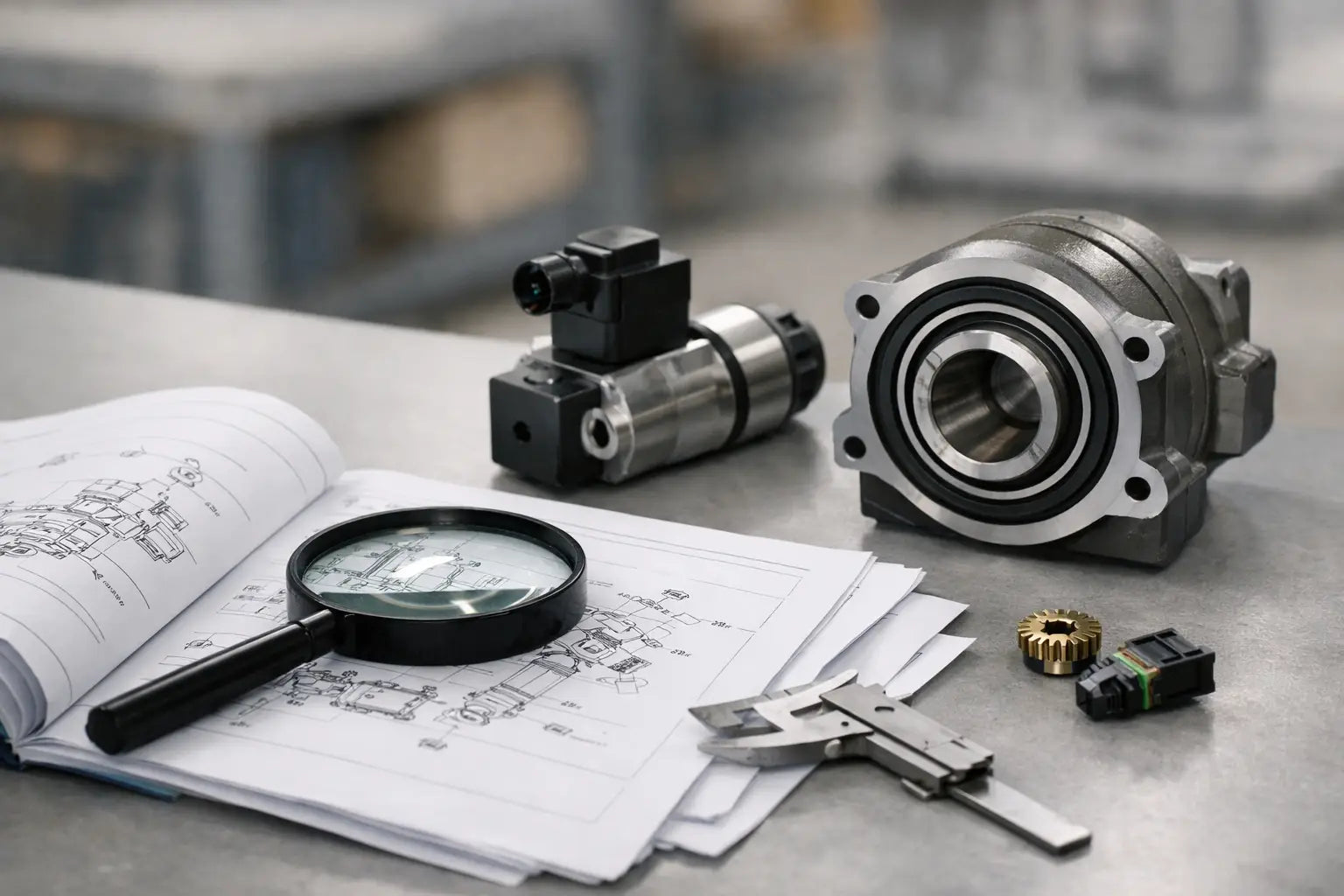
A boom cylinder is leaking, the machine is booked for work, and the old seal has already been removed. That is when a guide to equipment part number matching becomes a maintenance requirement, not a paperwork exercise. One incorrect digit, an assumed model variant, or a seal kit matched only by machine name can turn an urgent repair into additional downtime, return freight, and another teardown.
Part numbers are the fastest path to accurate replacement parts, but only when they are verified in the right context. Heavy equipment manufacturers reuse model names across markets, change component suppliers during production runs, and fit different cylinders or transmissions to similar machines. The goal is not simply to find a number that looks close. It is to confirm that the ordered part matches the installed component.
Why part number matching fails in the field
A machine model is a starting point, not a complete fitment record. A CAT excavator, Komatsu loader, SANY crane, or forklift may have multiple serial-number breaks, engine configurations, cylinder designs, and regional specifications. Two machines carrying the same model decal can use different rod seals, wipers, piston seals, bearings, or complete repair kits.
The same problem applies to numbers printed on old parts. A visible code may be a supplier number, a mold number, a batch code, or an internal manufacturing reference rather than the OEM service part number. It may identify a seal profile, but not the full kit or application. A part can also have been replaced previously with an aftermarket equivalent, making the installed marking different from the original equipment number.
Correct matching protects more than the purchase price. A seal with the wrong cross-section may leak immediately. A bearing with an incorrect width can damage a housing. A kit intended for a bucket cylinder may contain seals that are nearly identical to a boom-cylinder kit but cannot handle the same bore, rod, or pressure conditions. When labor and equipment availability are included, a low-cost mismatch is rarely low cost.
Guide to equipment part number matching: Start with the strongest identifier
Use the most specific information available. In most cases, the original OEM part number is the preferred reference because it connects directly to the manufacturer’s parts system and supersession history. Record the number exactly, including prefixes, suffixes, hyphens, spaces, and revision letters.
If the OEM number is unavailable, the component number is often the next-best option. For hydraulic work, that may be the cylinder assembly number stamped on the barrel or listed on the machine parts diagram. For final drives, pumps, motors, transmissions, and engines, use the component nameplate where possible. A component number is usually more reliable than matching a seal by appearance.
Machine details support the match. Provide the manufacturer, model, full serial number, and the relevant assembly location. “Excavator seal kit” is too broad. “SANY SY215C boom cylinder seal kit, machine serial number available” gives a parts specialist a practical basis for verification. If the repair involves a hydraulic cylinder, identify whether it is for the boom, arm, bucket, blade, steering, lift, tilt, outrigger, or another function.
For a fast and accurate request, capture these details before disassembly whenever possible:
- OEM part number from the parts book, invoice, or existing packaging
- Machine brand, model, and complete serial number
- Component or cylinder assembly number and application location
- Clear photos of labels, stampings, and the removed part
- Measurements taken with appropriate tools when a number cannot be confirmed
Check supersessions and cross-references carefully
OEM numbers change. Manufacturers may replace an earlier number with a revised design, consolidate several numbers into one service number, or change a supplied component without changing the machine’s sales model. This is normal, but it means an exact string search is not always enough.
A valid supersession should be supported by a manufacturer parts record, a trusted catalog cross-reference, or confirmed dimensional and application data. Do not assume that a number with one changed digit is a newer version. Some numbers differ only slightly while representing opposite-side parts, different pressure ratings, or different shaft diameters.
Aftermarket cross-references are useful when they identify a known equivalent from brands such as SKF, Hallite, NOK, Parker, Corteco, or CFW. Still, a cross-reference is not a substitute for fitment confirmation. Check the product description against the application, dimensions, material, and seal type. For example, an oil seal match requires more than inside diameter, outside diameter, and width. Lip arrangement, rotation direction, casing style, spring design, fluid compatibility, and dust exclusion may all matter.
The safest rule is simple: treat cross-reference results as a candidate part until the critical specifications agree.
Match seal kits by cylinder data, not color or appearance
Cylinder seal kits create many avoidable errors because individual seals can look similar across different applications. U-cups, buffer seals, wipers, O-rings, wear rings, and piston seals vary in dimensions and compound even when they share the same general profile.
When matching a hydraulic cylinder kit without a confirmed OEM number, measure the cylinder correctly. The key dimensions are generally rod diameter, bore diameter, piston diameter, gland dimensions, and seal groove dimensions where relevant. Verify the kit contents against the original configuration. A single-acting cylinder, double-acting cylinder, high-pressure boom cylinder, and low-pressure steering cylinder should not be treated as interchangeable repairs.
Material selection also depends on service conditions. Nitrile is common for mineral hydraulic oil, while polyurethane may be selected for abrasion resistance in dynamic sealing. Fluorocarbon materials may be needed for higher temperatures or specific fluids. The right profile in the wrong material can shorten service life just as quickly as the wrong size.
If the removed kit contains nonstandard spacers, backup rings, or custom-profile seals, stop before ordering a generic kit. Those details often indicate a design revision or a cylinder that requires application-specific parts.
Use dimensions as verification, not a shortcut
Dimensions are essential when markings are unreadable or parts are obsolete. They are also an effective final check for a number-based order. But dimensions alone can be incomplete.
A bearing may share bore, outside diameter, and width with another bearing but differ in internal clearance, seal arrangement, cage material, or load rating. An oil seal with identical nominal dimensions can have a different lip configuration. A hydraulic seal may fit the groove physically but be unsuitable for the operating pressure, speed, or temperature.
Measure clean parts with a calibrated caliper or micrometer. Avoid reading worn sealing lips, crushed O-rings, distorted wipers, or damaged housings as the original size. Where possible, measure the shaft, bore, and groove rather than relying only on the removed seal. Record measurements in millimeters unless the equipment documentation specifies otherwise, and state whether a value is a shaft diameter, housing bore, or seal width.
Confirm the order before dispatch
Before placing an urgent order, compare the order line with the repair requirement one final time. Check the manufacturer code, quantity, component location, and any stated dimensions. If a listing includes a machine model, make sure the machine’s serial range or component number does not introduce an exception.
For fleet teams, add this verification step to the work order process. Store confirmed OEM numbers, approved equivalents, cylinder dimensions, and previous purchase records by asset number. The next repair becomes faster, and technicians do not need to repeat identification work under pressure.
When information is incomplete, send the available part number, machine details, and photos for review rather than forcing a close match. MXPseal’s stock range covers equipment-specific kits alongside standardized seals and mechanical spare parts, but availability only delivers value when the part is right the first time.
A properly matched part gets the machine back to work. Take the extra few minutes to verify the identifier, application, and dimensions before dispatch - it is usually the fastest repair decision you can make.
Additional Identification Guides and Enquiries
If you have dimensions but no reliable part number, read our hydraulic seal kit dimensional matching guide or the rotary shaft oil seal size guide. You can also browse oil seals using a known dimension or part number.
For sourcing assistance, send the OEM number or stamped code, machine brand/model, serial or cylinder details where relevant, and photos to sales@maxiparts.com.sg or WhatsApp Maxi Parts. Any proposed cross-reference must be verified for the application before ordering.