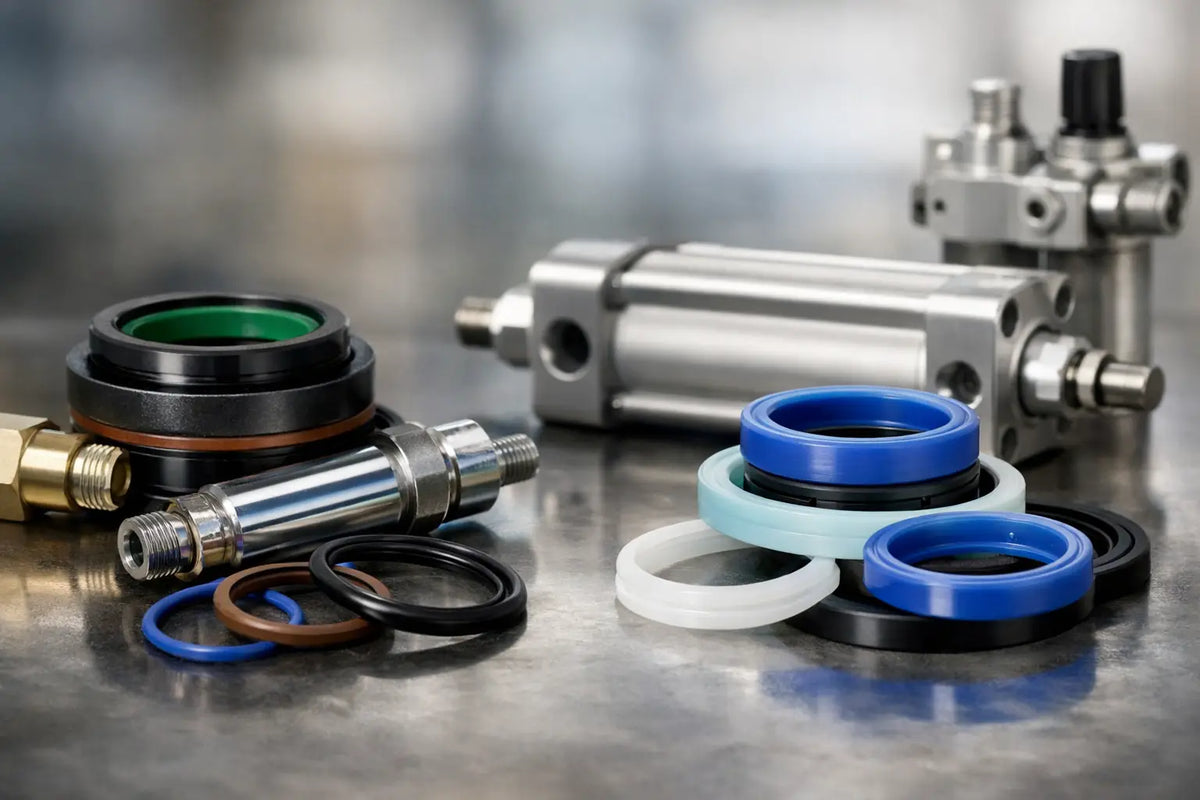
A cylinder that holds pressure on the bench can still fail quickly in service if the wrong sealing system is fitted. Hydraulic versus pneumatic seals may look similar by size or cross-section, but they are designed around different media, pressure ranges, lubrication conditions, and failure risks. For heavy-equipment repair, that difference affects leakage, rod scoring, cylinder drift, rebuild cost, and machine downtime.
Hydraulic Versus Pneumatic Seals: The Core Difference
Hydraulic seals contain pressurized fluid, typically hydraulic oil, inside cylinders, pumps, motors, valves, and related components. Their primary job is to prevent oil from bypassing a piston or escaping past a rod while maintaining efficient force transmission. Excavator boom, arm, bucket, tilt, steering, and lift cylinders depend on hydraulic sealing systems to hold substantial loads without internal or external leakage.
Pneumatic seals control compressed air or gas. They are common in air cylinders, actuators, valves, air tools, automation equipment, and some braking or suspension applications. Pneumatic systems usually operate at much lower pressures than hydraulic systems, but they often cycle faster and may run with limited lubrication. Air also carries moisture, fine debris, and compressor-related contamination that can change seal performance over time.
The practical rule is simple: a hydraulic seal is built to manage high-pressure fluid and oil-film lubrication, while a pneumatic seal is built for lower-pressure, faster-moving air applications with different friction and lubrication demands. Matching only the inside diameter, outside diameter, and height is not enough.
Pressure Changes the Seal Design
Hydraulic cylinders regularly operate at pressures far above those used in standard pneumatic systems. High pressure forces a seal against its mating surface, which can improve sealing but also increases extrusion risk. If the clearance between metal components is excessive, a soft seal lip can be pushed into the gap, cut, or permanently deformed.
This is why hydraulic piston and rod seals often use heavier profiles, anti-extrusion features, and support components such as backup rings or wear rings. A typical hydraulic cylinder may include a rod seal, wiper seal, buffer seal, piston seal, guide ring, and static O-rings. Each part handles a specific task under load and pressure.
Pneumatic seals generally need lower breakaway force and reduced running friction. A seal that is too tight may make a small air cylinder hesitate, stick at startup, or consume more air during operation. Pneumatic profiles are therefore often designed with flexible lips and geometry that responds quickly to changing air pressure. That does not mean pneumatic seals are light-duty by default. It means their design priorities are different.
Why hydraulic seals need support
In a high-pressure hydraulic application, the seal must resist extrusion while still following minor bore or rod imperfections. Material hardness, gland dimensions, pressure spikes, and radial clearance all matter. A seal that is correct for normal operating pressure may still fail if the machine sees shock loading, side loading, or a worn cylinder bore.
For boom and arm cylinders on excavators, pressure is only part of the picture. Contaminated oil, bent rods, damaged chrome, poor surface finish, and worn guide rings can overload an otherwise correct seal kit. Replacing the seal without checking these conditions can turn a quick repair into a repeat failure.
Lubrication Is Not the Same
Hydraulic oil provides a lubricating film between the seal lip and the moving rod or bore. Seal compounds for hydraulic use are selected to work with the fluid, temperature range, and expected pressure. Nitrile rubber, polyurethane, PTFE compounds, and fabric-reinforced materials are commonly used depending on the seal position and cylinder duty.
Pneumatic systems may receive lubricated air, but many operate with dry or minimally lubricated air. That changes the material requirement. A pneumatic seal must tolerate repeated motion without depending on a continuous oil film. It also needs to avoid excessive friction that can cause stick-slip movement, especially in positioning cylinders and automated equipment.
Using a hydraulic seal in a dry pneumatic cylinder can lead to high friction, poor response, or accelerated lip wear. Using a pneumatic seal in a hydraulic cylinder can result in swelling, extrusion, rapid leakage, or damage when pressure rises. Material compatibility with the working media is just as important as the seal profile.
Seal Types and Their Jobs
A complete hydraulic cylinder rebuild usually includes several seal functions. The rod seal retains hydraulic oil inside the cylinder. The wiper removes mud, dust, water, and abrasive particles from the rod as it retracts. The piston seal separates pressure chambers and prevents internal bypass. Wear rings keep the piston and rod centered to reduce metal-to-metal contact. Buffer seals may protect the main rod seal from pressure spikes.
Pneumatic cylinders can use rod seals, piston seals, and scrapers as well, but the geometry is often optimized for low friction and fast cycling. Some pneumatic piston seals are designed to allow controlled air flow or pressure energization in a specific direction. Installation orientation matters. Reversing a lip seal can prevent it from energizing correctly and cause immediate leakage or poor cylinder movement.
Seal names alone do not guarantee interchangeability. A U-cup, lip seal, compact seal, O-ring, or piston seal can be made in different materials and profiles for very different services. Always identify the application before selecting the replacement.
What to Check Before Ordering a Replacement
Part number matching is the fastest route when the OEM number, cylinder kit number, or equipment model is known. For machine-specific repairs, identify the cylinder location first. A boom cylinder kit, arm cylinder kit, bucket cylinder kit, tilt cylinder kit, and steering cylinder kit may all fit the same machine but use different dimensions and profiles.
When a part number is unavailable, measure the actual seal and the gland carefully. Confirm the rod diameter, bore diameter, groove width, groove depth, seal height, and whether the seal works on a rod or piston. Also record the original profile, lip direction, material appearance, and any backup ring or guide ring used with it.
Before purchasing, verify these operating details:
- Working medium: hydraulic oil, compressed air, water glycol, grease, or another fluid
- Maximum and normal operating pressure, including shock-load conditions
- Temperature range at the machine or installation site
- Rod or bore condition, including corrosion, scratches, pitting, and surface finish
- Motion type: slow load holding, high-frequency cycling, side-loaded service, or long stroke
Common Mistakes That Create Repeat Failures
The most expensive mistake is fitting a seal that is dimensionally close but not designed for the operating conditions. A generic seal may install easily and still fail within days under hydraulic pressure. The cost is not only another seal kit. It can include lost machine time, labor, oil, cylinder removal, and damage to the rod or barrel.
Another common issue is forcing seals over sharp threads, keyways, or rod edges without an installation sleeve or protective tape. A small nick in a seal lip can cause leakage from the first cycle. Clean assembly conditions also matter. Dirt trapped under a static seal or inside a cylinder can cut dynamic seals and contaminate the entire circuit.
Do not ignore gland dimensions. Cylinder components can be mixed during previous repairs, machined after damage, or fitted with nonstandard parts. If the groove is worn or incorrect, even a quality seal cannot maintain the right squeeze, clearance, or support. In these cases, dimensional verification is more reliable than ordering by machine model alone.
Choosing the Right Seal for the Job
For hydraulic equipment, select a seal system based on cylinder function, pressure, fluid type, rod speed, contamination exposure, and available gland dimensions. Heavy-duty excavator and loader cylinders typically need profiles that prioritize pressure stability, extrusion resistance, and dirt exclusion. Faster hydraulic equipment may also require lower-friction materials to reduce heat and improve response.
For pneumatic equipment, focus on air quality, lubrication condition, cycle rate, friction requirement, and bore finish. A pneumatic seal selected for dry air and rapid cycling may be a poor choice for lubricated shop air with a different temperature range, and vice versa.
MXPseal customers sourcing cylinder kits or individual replacement seals should use the OEM part number or exact dimensions whenever possible, then confirm the cylinder position and application. Ready stock is valuable when a machine is down, but correct fitment is what keeps the repair in service.
The best seal choice is the one that matches the actual cylinder, media, pressure, and working environment - not the one that merely resembles the old part. A few minutes spent verifying those details before dispatch can prevent a second teardown when the machine needs to be back on the job.