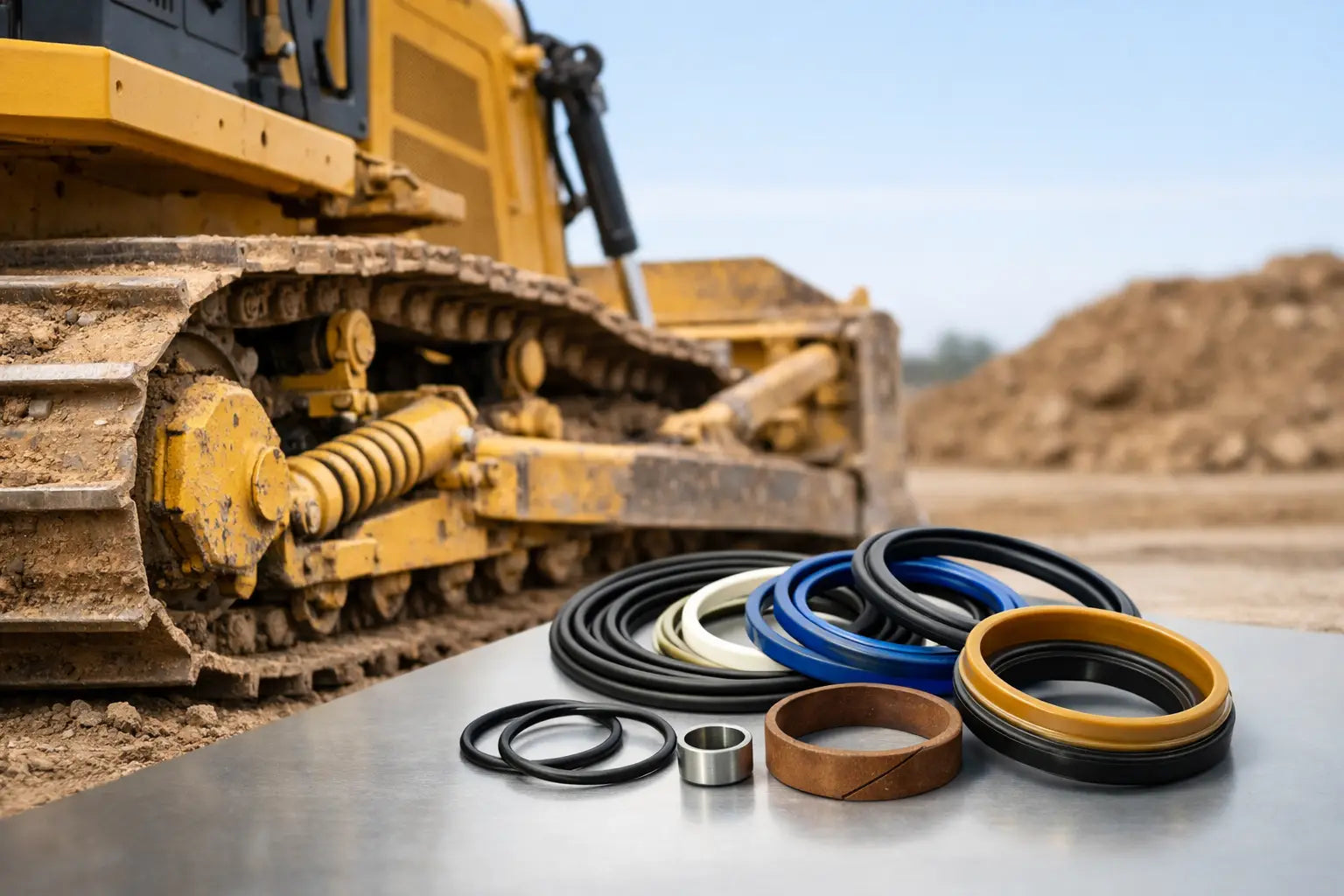
A bulldozer track adjuster seal kit is a small repair item with a direct effect on undercarriage availability. When the adjuster cylinder leaks grease, the track can lose tension, accelerate wear on the chain and sprocket, and turn a planned service stop into an urgent repair. Correct fitment matters more than choosing a kit that merely looks similar.
The track adjuster is part of a high-load system. Its grease cylinder pushes the front idler forward to maintain track tension, while the recoil spring assembly absorbs shock loads from rocks, stumps, and abrupt directional changes. A worn seal allows grease to bypass or escape at the adjuster, reducing the cylinder's ability to hold position. The visible symptom may be a loose track, but the underlying issue is usually internal seal failure, a damaged rod surface, a worn bore, or contamination introduced during prior service.
What a Bulldozer Track Adjuster Seal Kit Repairs
A track adjuster seal kit normally contains the sealing components required to rebuild the grease cylinder section of the adjuster. Depending on the machine design, this may include a piston seal, rod seal, wiper, O-rings, backup rings, wear rings, and static seals. Kit contents are not universal. Two kits with the same outside diameter can use different seal profiles, material compounds, or cross sections.
The job is not equivalent to replacing an ordinary hydraulic-cylinder kit. Track adjusters commonly operate with grease rather than hydraulic oil, see heavy side loading, and live in an abrasive environment beneath the machine. The seals must retain lubricant while excluding dirt, water, sand, and metal debris. A seal that fits loosely, has the wrong lip geometry, or is made for a different service medium may fail quickly even if installation appears successful.
Before ordering, identify whether the required repair is for the track adjuster grease cylinder, recoil spring assembly, idler group, or another undercarriage component. Parts descriptions can be inconsistent across equipment makes, especially where an OEM part number has been superseded. Use the machine serial number, exact model, adjuster assembly number, and existing seal dimensions wherever possible.
Signs the Track Adjuster Needs Attention
Grease around the adjuster cylinder or behind the front idler is the most common warning sign. A machine that repeatedly develops excess track sag after adjustment also deserves inspection. Operators may keep adding grease to restore tension, only to find that the track loosens again after a few operating hours. This is not a tension-setting issue if grease is escaping internally or externally.
Inspect the exposed rod and cylinder area before assuming the seals are the only fault. A scored rod can cut a new rod seal. Corrosion pits, chrome flaking, or an out-of-round cylinder bore can prevent a replacement kit from holding pressure. Check for damaged grease fittings and blocked grease passages as well. If grease cannot enter the adjuster correctly, the machine may appear to have a cylinder fault when the restriction is elsewhere.
Track wear patterns provide another useful clue. A loose track can increase impact loading and contribute to accelerated bushing, roller, idler, and sprocket wear. Over-tightening is not the cure. It creates additional load and can shorten undercarriage life. Set sag to the equipment manufacturer's specification after the repair, accounting for the operating condition and whether the machine typically works in mud, rock, or packed material.
How to Match the Correct Seal Kit
Part-number matching is the best starting point. OEM part numbers, machine model references, and adjuster assembly numbers reduce the risk of ordering a kit based on appearance alone. However, part numbers should be checked against the machine serial range, since manufacturers may change cylinder designs within the same model family.
Where the original number is unavailable, measure the removed seals and hard components carefully. The critical references usually include rod diameter, cylinder bore, piston diameter, seal groove width, groove depth, and seal cross section. Record whether each component is a rod seal, piston seal, wiper, O-ring, or backup ring. A measurement without a component location can lead to the wrong kit.
Seal material also matters. Nitrile compounds are widely used for grease and oil service, while polyurethane may be selected for high abrasion resistance in some dynamic applications. PTFE-based designs can offer low friction and good extrusion resistance but may require a specific gland design. The correct choice depends on the original seal configuration, pressure conditions, temperature exposure, and cylinder condition. Do not substitute materials simply because the dimensions appear close.
For fleet maintenance teams, retaining the old kit label, the machine serial number, and a clear photo of the removed seal stack can speed up future procurement. This documentation is especially useful for mixed fleets, older machines, and equipment with replacement undercarriage assemblies fitted during previous repairs.
Installation Risks That Cause Early Failure
Track adjuster repair involves more than changing seals. Recoil spring assemblies store significant energy, and incorrect disassembly can cause severe injury or equipment damage. Follow the machine service procedure, use the specified restraining tools, and ensure the work is performed by qualified personnel. Never treat the recoil spring and adjuster assembly as a standard bench cylinder.
During cylinder work, clean every component before inspection and assembly. Dirt trapped in a seal groove, a sharp burr on the piston, or a scratched rod can damage new seals immediately. Use appropriate installation tools so seal lips are not stretched, twisted, or cut over threads and edges. Lubricate components with a compatible grease or assembly lubricant as required by the seal design and service procedure.
Pay close attention to seal orientation. A rod seal installed backward may allow grease to pass under pressure. A wiper installed incorrectly can admit contamination rather than exclude it. Backup rings must be positioned on the pressure side of the associated O-ring where the design requires it. These details are easy to miss when components are removed in a single pile, so lay out the old parts in sequence before disassembly.
After reassembly, grease the adjuster gradually and inspect for leakage before returning the machine to full production. Confirm that the idler moves correctly, set track sag to specification, then recheck after initial operation. If the machine still loses tension, stop adding grease and inspect the cylinder, grease valve, and adjuster assembly for damage or incorrect assembly.
Stocking Parts for Faster Undercarriage Repairs
For contractors and rental fleets, a track adjuster failure rarely occurs at a convenient time. Keeping commonly used seal kits, grease fittings, O-rings, and related undercarriage service parts on hand can reduce waiting time when a machine is needed on a grading, clearing, or site-preparation job. The right stocking level depends on fleet size, machine age, operating hours, and how quickly replacement parts can reach the workshop.
For one-off repairs, avoid buying on broad descriptions such as “dozer adjuster seals.” Supply the model, serial range, OEM reference, and dimensions when available. An exact kit match is less expensive than repeated teardown, lost grease, and premature undercarriage wear. MXPseal supports this type of parts identification with machine-specific seal kit references and dimensional matching for maintenance buyers who need a clear fitment decision.
A properly matched kit will not correct a damaged adjuster cylinder or a worn recoil assembly, but it gives a serviceable unit the best chance of holding tension and staying in operation. Verify the application before dispatch, inspect the hard parts during teardown, and treat the final tension setting as part of the repair rather than an afterthought.