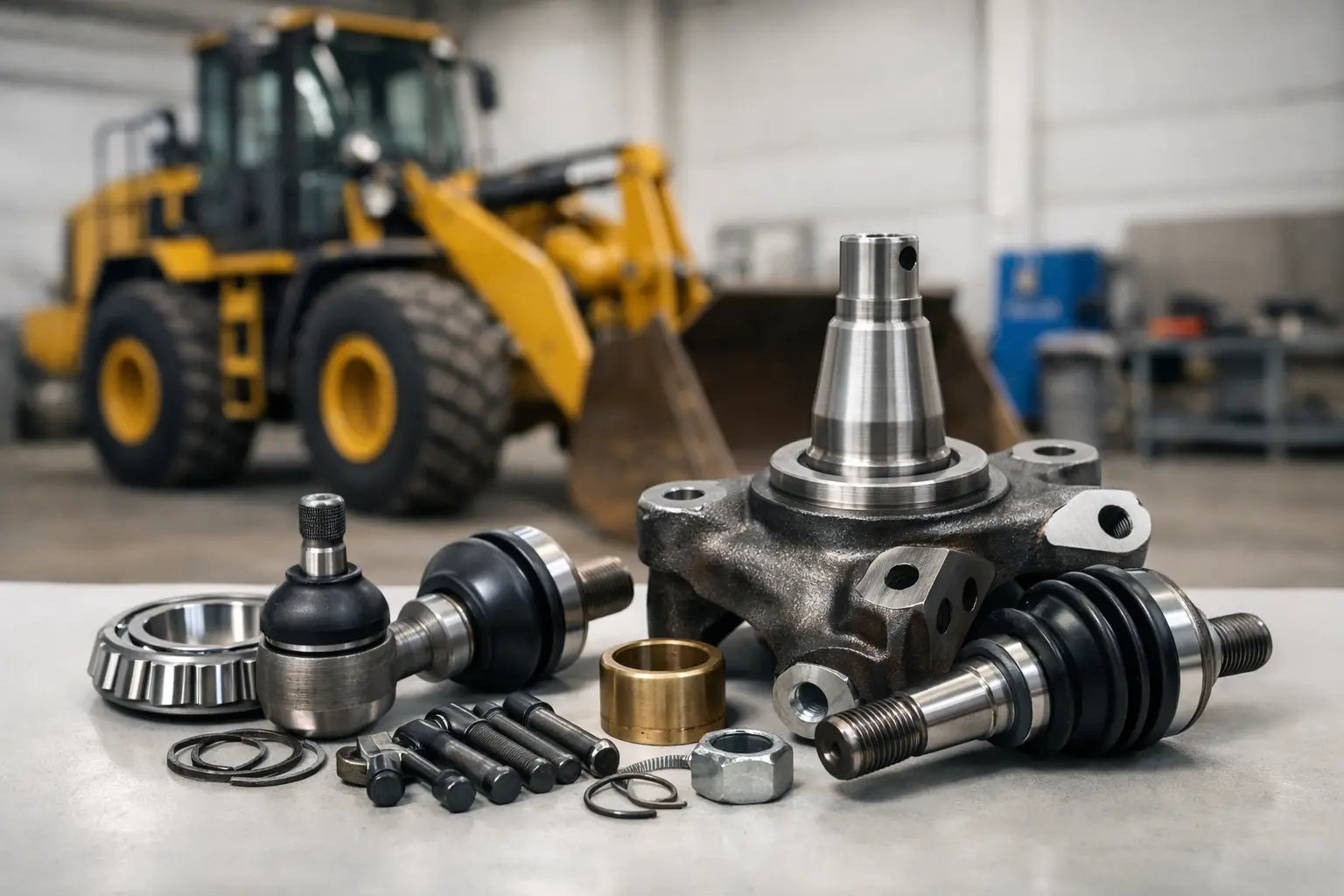
A wheel loader with front-end wander, uneven tire wear, or oil appearing around the hub is not a machine to keep running until the next scheduled service. Wheel loader steering knuckle parts carry steering loads, transfer axle forces, and protect critical bearing and seal interfaces at the wheel end. A wrong component can create repeat repairs, damage a hub or axle housing, and keep a loader out of service longer than the original failure.
For repair shops, fleets, and equipment dealers, the job is not simply finding a part described as a steering knuckle. Accurate sourcing starts with the axle configuration, machine serial range, OEM reference, and the exact damaged position. Similar loaders can use different axles, knuckle arms, hub dimensions, and seal arrangements.
What the Steering Knuckle Assembly Does
The steering knuckle is the pivoting wheel-end structure that allows the wheel to turn while supporting loads transmitted through the axle, hub, bearings, and steering linkage. On many articulated wheel loaders, the term may be used for a front axle wheel-end component rather than the machine's center articulation joint. Catalog terminology differs by manufacturer, so verify the illustration and part description before ordering.
A typical wheel-end steering knuckle assembly can involve the knuckle body, kingpin or pivot pin, upper and lower bushings, thrust washers or bearings, seals, retaining hardware, steering arm, tie-rod connection, and hub-related components. Some axle designs integrate certain pieces into a carrier or reduction housing. Others use separate left-hand and right-hand parts that look similar but are not interchangeable.
The knuckle body itself is usually a high-strength casting or forging. It must maintain correct alignment under repeated loading from bucket work, travel over rough ground, braking, and steering cycles. Wear in the surrounding pivot components often shows up first as vertical or lateral movement at the tire, but the knuckle bore, steering arm, and mounting faces must also be inspected before a rebuild is approved.
Common Wheel Loader Steering Knuckle Parts Failures
Knuckle failures are rarely isolated. Contaminated lubricant, worn seals, incorrect preload, loose hardware, and overloading can each shorten the life of adjacent components. The repair decision should be based on inspection findings, not only on the first visibly damaged part.
Pivot wear and steering play
Excessive clearance at the kingpin or pivot pin is a common issue. The operator may report loose steering response, clunking during direction changes, instability while carrying a load, or uneven front tire wear. During inspection, support the axle safely and check movement at the wheel end according to the machine service procedure.
A new pin installed in an ovalized knuckle bore will not provide a lasting repair. Measure the pin, bushing outside diameter, bushing bore, and the knuckle bore. Depending on the axle design and available service parts, the correct repair may require bushings, an oversize pin, a replacement knuckle, or a complete pivot repair kit.
Seal leaks at the hub or pivot area
Oil or grease around the wheel end can come from a hub oil seal, axle shaft seal, pivot seal, damaged wear sleeve, or a breather issue. Do not assume every leak requires the same seal. Seal dimensions, lip arrangement, material, and installation orientation all matter.
Before fitting new seals, inspect the shaft or mating surface for grooves, corrosion, heat marks, and scoring. A seal fitted onto a worn running surface may stop the leak briefly but will usually fail early. Check bearing condition and lubricant contamination at the same time. Water entry or metallic debris changes the scope of the repair.
Cracked arms, damaged threads, and impact damage
Wheel-end components see heavy shock loads. Impacts with curbs, rock, stockpile edges, or trench walls can bend a steering arm, damage a tie-rod taper, crack a casting, or strip threads. Any suspected crack in a load-bearing knuckle or steering arm requires careful assessment. Reusing a visibly compromised part to save cost can lead to a more expensive axle failure.
Thread damage also needs attention. Confirm whether the damaged thread belongs to a replaceable stud, a serviceable arm, or the knuckle casting itself. Do not substitute bolts or hardware based on diameter alone. Strength grade, shank length, locking method, and torque specification are part of the fitment.
How to Identify the Correct Replacement Part
Part-number matching is the fastest route when the original OEM number is available and tied to the correct machine serial number. However, an OEM number alone can be insufficient if the loader has received an axle conversion, updated hub group, or prior nonstandard repair.
Start with the loader manufacturer, model, serial number, axle make and axle identification tag. Major wheel loader platforms may be fitted with different axle suppliers across production runs. Record whether the part is for the left or right side, front or rear axle, and upper or lower pivot position where applicable.
Then compare the removed component against the replacement drawing, photos, and dimensions. Useful verification points include the overall knuckle shape, pivot bore diameter, bearing seat dimensions, steering arm location, tie-rod taper, bolt-hole count and spacing, hub mounting flange, and seal land diameter. For seal-related wheel loader steering knuckle parts, also confirm the seal cross section and the surface on which the seal runs.
Do not rely on a machine model name stamped into a customer request. A model family can cover years of production, multiple engine variants, and several axle configurations. Clear photos of identification tags and the removed part can prevent an incorrect dispatch and the downtime that follows.
Replace Related Wear Parts When Access Is Open
Disassembling a wheel-end steering knuckle is labor-intensive. If the pivot has been opened and bushings or bearings show measurable wear, replacing only one damaged item can be a false economy. The right scope depends on condition, machine hours, and parts availability, but related service items should be evaluated together.
During the repair, inspect the kingpin or pivot pin, bushings, thrust washers, shims, O-rings, dust seals, hub seals, bearings, lock plates, retaining rings, and steering-linkage joints. If an oil seal has failed, inspect the bearing and lubricant rather than treating the seal as the sole cause. If the steering arm has been removed, check the tie-rod end and taper for movement or fretting.
This does not mean replacing good parts without evidence. A loader in controlled yard service may have limited wear, while a machine operating in quarry dust, mud, water, or high-cycle loading may justify a more complete repair kit. Measure first, then order to the actual condition and the repair standard required by the fleet.
Installation Details That Protect the Repair
Cleanliness matters at every bearing and seal interface. Remove old seal material without scoring housings, clean out abrasive contamination, and keep new parts protected until installation. Press bushings and bearings squarely using the correct support points. Driving force through a rolling bearing's wrong race can damage it before the machine returns to work.
Follow the equipment manufacturer's torque values, preload procedure, shim selection method, and lubrication requirements. Pinch bolts, steering arm fasteners, and hub retainers must be tightened in the specified sequence. Where the service procedure calls for new lock nuts, cotter pins, locking plates, or thread locking compound, use them.
After assembly, check steering movement lock-to-lock, wheel-end free play, hydraulic steering response, and any leak points before releasing the machine. A short controlled test under load can reveal looseness or abnormal noise that is not obvious with the axle suspended. Recheck fasteners where the OEM procedure requires it.
Buy for Fitment, Availability, and Repair Scope
Urgent maintenance purchasing should not force a choice between speed and verification. The best supplier can confirm the part classification, match dimensions or OEM references, and provide associated seals, bearings, and repair components from available stock. That reduces split orders and avoids holding a stripped-down loader while one small seal or retainer is still in transit.
MXPseal supports this kind of purchasing with equipment-specific replacement parts, sealing products, bearing options, and technical identifiers that help maintenance teams match what is actually on the axle. For a steering-knuckle job, provide the machine and axle details, OEM numbers if available, clear photos, and measured dimensions for any uncertain seal or bushing.
Treat the wheel-end repair as an axle reliability job, not a single-part replacement. Correct fitment, clean installation, and inspection of the surrounding wear items give the loader a better chance of returning to productive work without an early repeat failure.