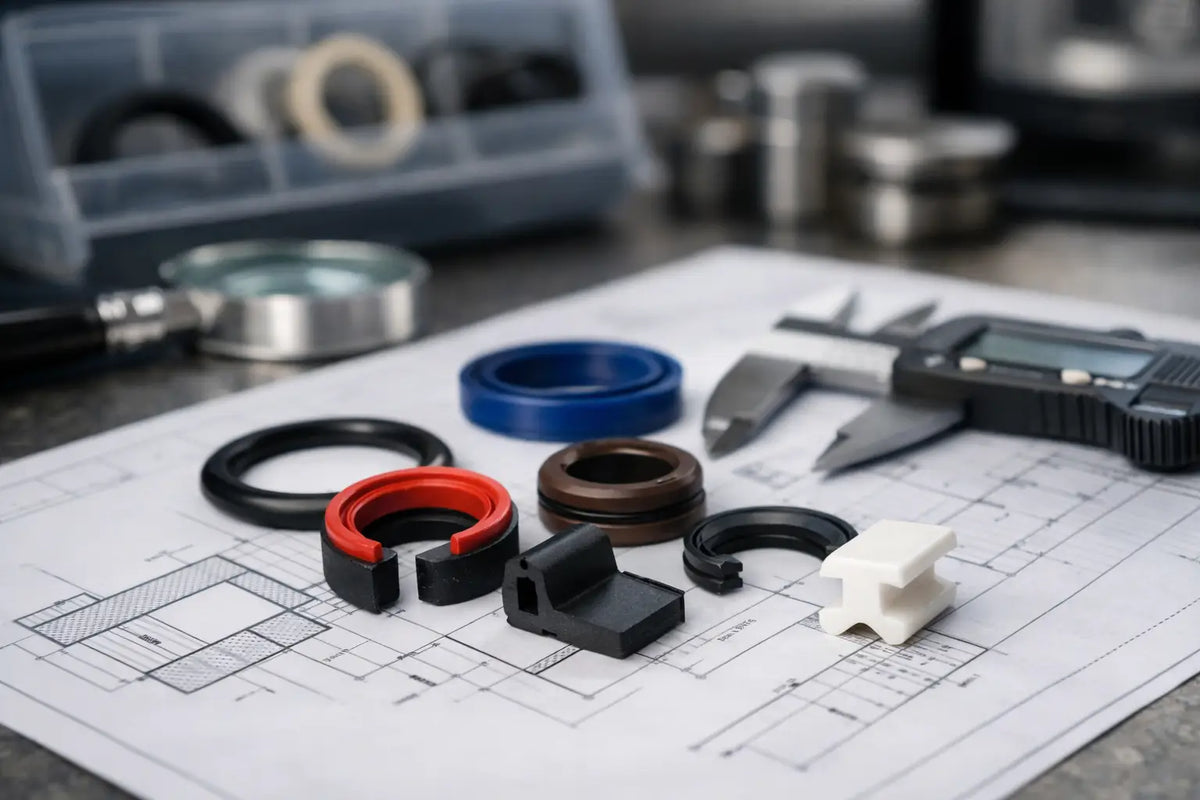
A seal that looks close is not necessarily a replacement. A rod seal installed in the wrong groove can leak immediately, while an oil seal with the wrong lip arrangement may allow contamination into a bearing housing. Knowing how to identify seal profiles from the removed part, groove, and machine application reduces repeat repairs, return delays, and unnecessary equipment downtime.
For heavy equipment, start with the cylinder or component location and work toward the exact seal shape, dimensions, material, and part number. A clear photo helps, but measurements and application details are what confirm fitment.
Start With the Seal's Job and Location
The fastest way to narrow down a seal profile is to identify what the seal does. Hydraulic cylinders commonly contain a rod seal, wiper seal, piston seal, wear ring, static O-ring, and backup ring. Each part has a distinct location and function.
A rod seal sits in the cylinder head or gland and seals against the moving chrome rod. It holds hydraulic pressure inside the cylinder as the rod extends and retracts. A wiper, also called a scraper or dust seal, sits at the outermost end of the gland. Its purpose is to remove dirt, water, mud, and abrasive material from the rod before contaminants reach the rod seal.
A piston seal is installed on the piston and separates the pressure chambers inside the barrel. In a double-acting cylinder, it must seal pressure in both directions. Wear rings or guide rings support the piston or rod and prevent metal-to-metal contact. They guide rather than seal, but their dimensions still matter during a full cylinder rebuild.
Rotary applications are different. An oil seal is generally fitted into a housing and runs against a rotating shaft. It may be used in wheel hubs, final drives, gearboxes, pumps, motors, and axle assemblies. Its profile can include a primary sealing lip, a dust lip, a garter spring, or a metal-cased outer diameter.
Before measuring anything, record the machine brand, model, serial range if available, component location, and cylinder position. “Excavator seal kit” is too broad for accurate ordering. “Komatsu boom cylinder,” “SANY bucket cylinder,” or “forklift tilt cylinder” provides the application detail needed to verify the correct kit.
How to Identify Seal Profiles by Shape
Once the part is removed and cleaned, examine its cross-section rather than judging it from the face. The profile is the seal's side view - the geometry that fits the groove and contacts the rod, bore, shaft, or mating component.
Hydraulic rod seals
Common rod seal profiles include U-cups, lip seals, compact seals, and loaded profiles. A standard U-cup has an open side that faces pressure. The pressure energizes the sealing lips against the rod and gland bore. Reversing it can cause leakage or poor pressure retention.
Some rod seals have a fabric-reinforced outer diameter, a nitrile or polyurethane body, or a separate energizer ring. Others have asymmetric lips, meaning the inner and outer lips are deliberately different. These details affect groove fit, friction, extrusion resistance, and service life.
Do not assume two U-shaped seals interchange just because the rod diameter is the same. Groove width, seal height, outer diameter, lip design, and material may differ.
Piston seals
Piston profiles are usually designed for bidirectional pressure. You may find a single-piece double-acting seal, a PTFE sealing ring with an elastomer energizer, a polyurethane compact piston seal, or a multi-piece assembly using separate sealing and support elements.
A piston seal that appears as a simple ring may actually be part of a set. Keep every removed piece together in order. A missing energizer, backup ring, or wear ring can lead to an incorrect replacement selection.
Wipers and scrapers
Wipers have a wiping edge that contacts the rod near the outside of the cylinder head. Some are press-fit metal-cased designs, while others are snap-in elastomer profiles. Heavy-duty wipers may have a second lip to retain grease or a reinforced body for harsh construction and mining environments.
Check whether the wiper mounts in an open groove, a closed groove, or a metal housing. This is often the difference between visually similar profiles.
Oil seals
Oil seals are identified by their outside case, lip arrangement, spring, and shaft application. A single-lip seal is normally intended to retain lubricant. A double-lip seal adds an auxiliary dust lip for contaminated environments. The garter spring is typically fitted around the main oil-retaining lip, not the dust lip.
Also inspect the outer diameter. A rubber-covered outside diameter, metal-cased outside diameter, and ribbed sealing outside diameter are different profiles. Housing condition matters here: a damaged or loose bore may require a profile that provides more outside-diameter retention.
Measure the Seal and the Groove
Dimensions confirm the profile. Use clean calipers and measure in millimeters whenever possible, since most hydraulic seal and heavy-equipment part references use metric sizing.
For a rod seal, measure the rod diameter, gland bore diameter, groove width, and groove depth if the gland is accessible. For a piston seal, measure the cylinder bore, piston groove diameter, groove width, and groove depth. For an oil seal, the standard order is shaft diameter x housing bore x seal width.
Measure the old seal as a reference, but do not rely on it alone. Heat, pressure, chemical exposure, and long service can distort elastomer seals. A worn seal may be undersized, flattened, hardened, or torn. The machined groove dimensions are more reliable than the removed seal's dimensions.
When a groove cannot be measured easily, record the cylinder bore, rod diameter, piston diameter, and all visible part markings. A cylinder repair shop may also identify the seal from the gland design and machine application.
Check Material Before Matching a Replacement
Profile and dimensions are only part of the job. The wrong material can fail even when it fits perfectly.
Nitrile rubber, commonly called NBR, is widely used for mineral hydraulic oil and general oil-seal applications. Polyurethane is common in high-wear hydraulic rod and piston seals because it handles abrasion well. PTFE is used where low friction, high pressure, temperature range, or chemical resistance is required, often with an O-ring energizer.
FKM, also known by the trade name Viton in some applications, is selected for higher-temperature fluids and certain chemical environments. It is not a universal upgrade. Material selection depends on fluid type, operating temperature, pressure, rod speed, contamination, and groove design.
For example, a polyurethane seal can be an excellent choice for an excavator cylinder working in abrasive conditions, but a different material may be required for a high-temperature rotary application. Match the original specification when possible, especially on OEM hydraulic systems.
Use Markings and Part Numbers as Evidence
Many seals carry molded, stamped, or printed identifiers. Clean the part carefully and inspect both faces, the outer diameter, metal case, and packaging. A partial code can still be useful when combined with dimensions.
OEM cylinder kits and branded seals may reference a machine part number, a manufacturer code, a size string, or a profile designation. Record every character exactly, including hyphens and suffixes. One digit can separate a boom-cylinder kit from an arm-cylinder kit or identify a revision for a different serial range.
If the original part number is unavailable, provide the equipment make and model, cylinder location, dimensions, clear photos of the removed components, and any casting or cylinder numbers. This gives a supplier enough information to cross-check a kit or individual seal against available inventory.
Avoid the Most Common Identification Errors
The most expensive mistake is ordering by appearance alone. A black seal is not automatically nitrile, a blue seal is not automatically polyurethane, and a spring-loaded lip is not automatically the correct oil seal. Color can vary by manufacturer and production batch.
Another common error is mixing up a rod seal and a wiper because both fit around the same rod. Their groove dimensions and working faces are different. Installing two pressure seals where a wiper belongs can create friction, heat, and premature rod damage.
Avoid measuring only one dimension. A seal listed as 50 mm may refer to a rod diameter, shaft diameter, bore diameter, or an outside diameter. Always state what each measurement represents. For oil seals, use shaft x bore x width. For hydraulic seals, identify the rod or bore size and the complete groove dimensions.
Finally, do not replace only the visibly damaged seal if the cylinder is already dismantled and a complete kit is available. Contaminated oil, a scored rod, damaged chrome, or worn guide rings can destroy a new seal quickly. Inspect the rod surface, barrel, piston, gland, and groove edges before reassembly.
Accurate seal identification is a maintenance step, not a catalog search shortcut. Keep the removed seal set, measurements, machine details, and photos together before ordering. That small amount of discipline makes it far easier to match the right profile, secure stock quickly, and return the machine to service without a second teardown.