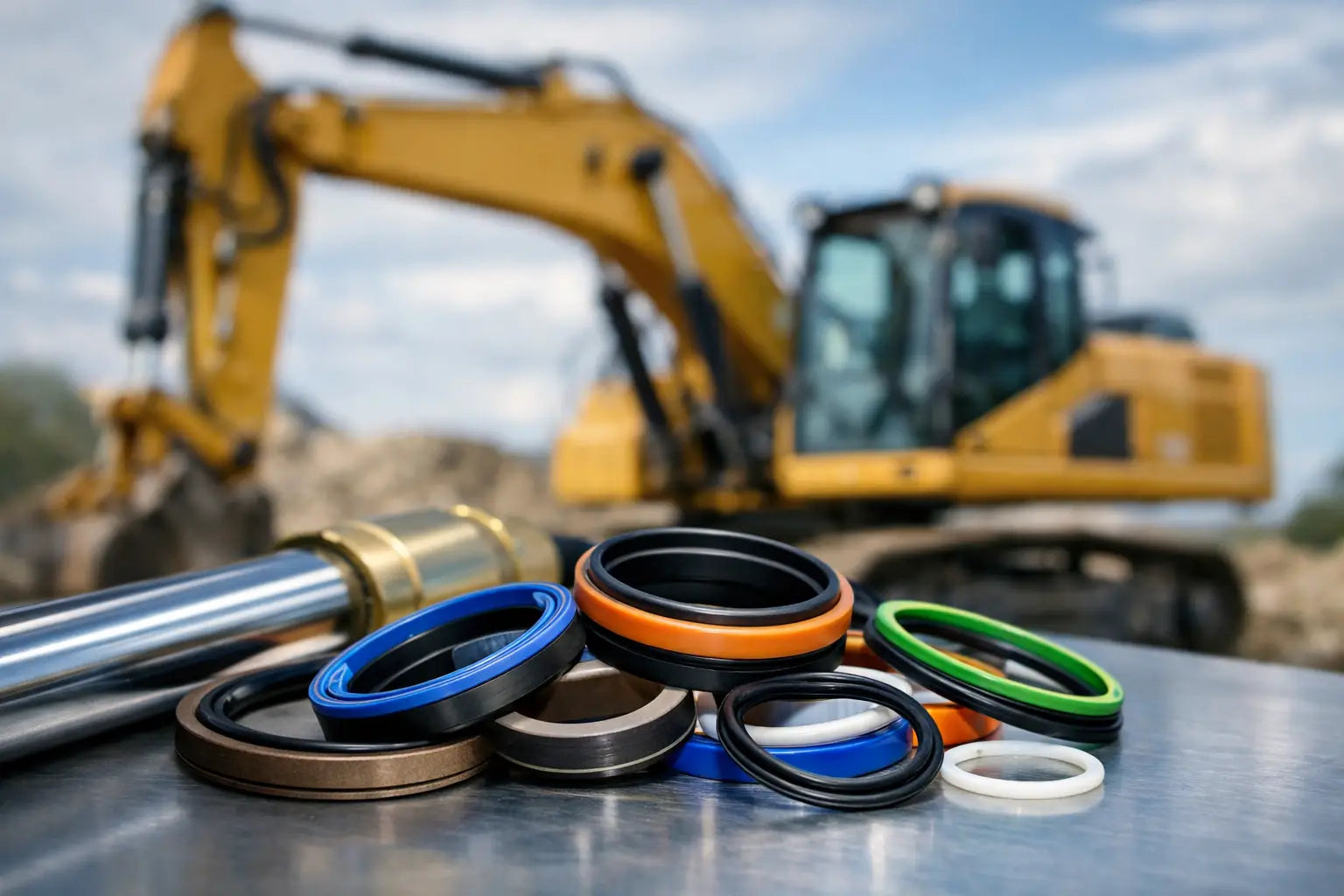
A boom cylinder that drifts under load, a bucket cylinder that loses breakout force, or a tilt cylinder that bypasses internally can all point to the same repair decision: hydraulic piston seal selection. The wrong seal may fit the piston groove and still fail early if its material, profile, or support components do not match the actual cylinder duty.
For heavy-equipment repairs, a piston seal is not a generic wear item. It has to hold pressure on one side of the piston while allowing the rod to extend and retract thousands of times through contaminated, high-load working cycles. Accurate matching starts with the cylinder application, then moves through dimensions, pressure, fluid, temperature, and the condition of the bore and rod.
Start With the Cylinder Function
The piston seal separates the pressure chambers inside a double-acting hydraulic cylinder. If it leaks internally, oil passes from the pressurized side of the piston to the opposite side. External leakage may not be visible, but machine performance will suffer. Common symptoms include cylinder drift, slow movement under load, reduced lifting capacity, heat buildup, and inconsistent control response.
Do not confuse the piston seal with the rod seal. The rod seal controls oil at the gland as the rod moves out of the cylinder. The piston seal works inside the barrel, where it must resist pressure differential and maintain sealing contact against the cylinder bore. A complete cylinder repair may also require wear rings, piston backup rings, rod seals, wipers, O-rings, and static seals, but each component has a separate job.
Cylinder position matters. A boom, arm, bucket, blade lift, steering, outrigger, or forklift tilt cylinder can operate under very different side loads, cycling frequency, and peak pressures. An excavator boom cylinder may see long loaded holds and high pressure spikes. A steering cylinder may cycle frequently with shorter strokes. Match the seal to the application instead of choosing only by diameter.
Build the Specification Before Choosing a Seal Profile
A correct replacement begins with usable technical information. The best source is the equipment parts manual or cylinder drawing, particularly when it provides an OEM kit number or a piston seal part number. For older, rebuilt, or mixed-origin cylinders, verify the physical measurements as well.
Record the bore diameter, piston diameter, seal groove width, groove depth, and the dimensions of any backup rings or wear rings. Measure a cleaned component with suitable calipers, and compare the readings with the old seal profile rather than relying on an approximate outside diameter. A few thousandths of an inch can determine whether a seal has enough squeeze to seal or enough clearance to survive pressure.
Also confirm these operating details:
- Maximum working pressure and likely pressure spikes
- Hydraulic fluid type, including mineral oil, biodegradable oil, or specialty fluid
- Normal and peak operating temperature
- Expected contamination, side loading, and duty cycle
Choose the Profile for Pressure and Clearance
Several piston seal designs are common in mobile hydraulic cylinders. There is no single best profile for every repair.
U-Cup and Single-Acting Piston Seals
U-cup style piston seals are widely used where the lip design can be pressure energized against the cylinder bore. They are compact, economical, and effective when the groove geometry, pressure direction, and material are correct. Some are intended for one pressure direction, while double-acting cylinders require a suitable opposing arrangement or a double-acting seal design.
A simple U-cup can be a good option for a cylinder operating within standard pressure and clearance limits. It becomes less forgiving when bore wear, piston clearance, or pressure spikes are excessive. Installing a lip seal without checking its pressure direction is a basic but costly mistake.
Compact Double-Acting Piston Seals
Compact piston seals are designed to seal in both directions within a defined piston groove. They are often used in construction equipment cylinders because they combine pressure sealing with a space-efficient design. Depending on the design, they may use polyurethane, nitrile rubber, fabric-reinforced rubber, or an elastomer energizer with thermoplastic sealing elements.
This type is often appropriate when replacing an existing OEM-style piston seal with the same groove arrangement. Do not substitute a compact seal simply because the piston diameter matches. Groove width, groove depth, and the location of support rings must also match.
PTFE Ring and Energized Seal Assemblies
PTFE piston rings with elastomer energizers are selected where low friction, chemical resistance, high speed, or broad temperature range is required. They can provide excellent performance, especially in properly finished bores, but installation and sizing are less forgiving than a basic elastomer seal.
PTFE-based seals generally need support rings or backup rings when pressure and extrusion clearance demand it. They are not automatically the better repair choice for worn mobile-equipment cylinders. If the bore has scoring, corrosion, or excessive clearance, the cylinder should be inspected and repaired before fitting a premium low-friction seal.
Chevron and Multi-Component Packing Sets
Chevron or V-packing arrangements use multiple sealing elements that can be adjusted or configured for demanding service. They remain common in certain industrial and older cylinder designs. Their advantages include adaptability and strong sealing under high load, but they take more axial space and must be installed in the correct order.
When replacing a packing set, match the full stack height and component sequence. Mixing rings from different profiles can alter compression and create excessive friction or early leakage.
Match Material to Fluid and Temperature
Seal material is a performance decision, not just a catalog detail. Polyurethane is common in heavy-equipment hydraulic service because it offers strong wear resistance and good extrusion resistance. It is often a practical choice for excavators, loaders, forklifts, and similar equipment operating on standard mineral hydraulic oils.
Nitrile rubber, often identified as NBR, has broad compatibility with petroleum-based hydraulic fluid and is frequently used in energized seal assemblies and static sealing components. It may not be suitable for every temperature range or specialty fluid. Fluoroelastomer materials can handle higher temperatures and certain fluids better, but the additional cost only makes sense when the operating environment requires it.
Fluid compatibility should be checked before ordering. A machine converted to biodegradable hydraulic oil, operating in unusual ambient temperatures, or running a nonstandard fluid may need a different seal compound than the original setup. If the fluid has changed, confirm every soft component in the cylinder, not only the piston seal.
Check Extrusion Risk and Support Components
High pressure forces seal material into any available clearance between the piston and cylinder bore. This is extrusion. It can cause nibbling, torn lips, rapid bypass, and seal fragments circulating through the hydraulic system.
Backup rings are used to limit this movement. Their need depends on system pressure, pressure spikes, seal material, bore condition, and piston-to-bore clearance. A seal that performs well at moderate pressure can fail quickly on a hammer circuit, lifting cylinder, or machine that regularly reaches relief pressure.
Wear rings also matter. They guide the piston, reduce metal-to-metal contact, and help control side loading. Reusing worn, cracked, or undersized wear rings can allow piston movement that damages a new seal. If the cylinder has a piston seal, wear ring, and backup-ring arrangement from the factory, replace the assembly as a matched set unless the cylinder specification clearly calls for another configuration.
Inspect the Cylinder Before Installing New Seals
A new seal kit cannot correct mechanical damage. Inspect the cylinder bore for scoring, pitting, corrosion, or ovality. Check the rod for chrome damage, bends, and surface defects. Examine the piston for damaged grooves, loose retaining hardware, sharp edges, and signs that an old seal has extruded.
Pay close attention to the bore finish. Deep scoring gives pressurized oil a leak path and can cut a seal during operation. Sharp groove edges can damage the seal on installation. Clean up minor burrs as appropriate, but do not treat serious bore damage as a seal-only repair.
Contamination is another frequent cause of repeat failure. Dirt entering past a damaged wiper can score the rod and move into the cylinder. Metal particles from pump or valve damage can cut seal lips. Before assembly, flush contaminated components and identify the source. Replacing seals without addressing contamination often turns an urgent repair into a second teardown.
Avoid Common Ordering Errors
The fastest route to the wrong part is ordering by machine model alone. Equipment manufacturers may use different cylinder versions across production years, serial ranges, attachments, and regional configurations. A 20-ton excavator, for example, can have multiple boom-cylinder and arm-cylinder seal kits that are not interchangeable.
Use the OEM part number when available, then verify cylinder location and dimensions. If the part number is unavailable, provide the machine make, model, serial range, cylinder application, bore size, rod size, piston dimensions, and photos of the old seal profile. This gives the parts team enough information to narrow the correct kit instead of guessing from the machine family.
For urgent repairs, order from stock and confirm exactly what is included. A piston seal may be available individually, while a full cylinder kit may include the rod seal, wiper, O-rings, backup rings, and wear rings required to complete the job. MXPseal supports this type of part-number and fitment-based sourcing across heavy-equipment seal kits and replacement components.
A hydraulic cylinder only performs as well as the seal system fitted inside it. Take the extra time to verify the original profile, groove dimensions, operating conditions, and support components before placing the order. That check is usually faster and less expensive than pulling the cylinder back off the machine after a premature failure.