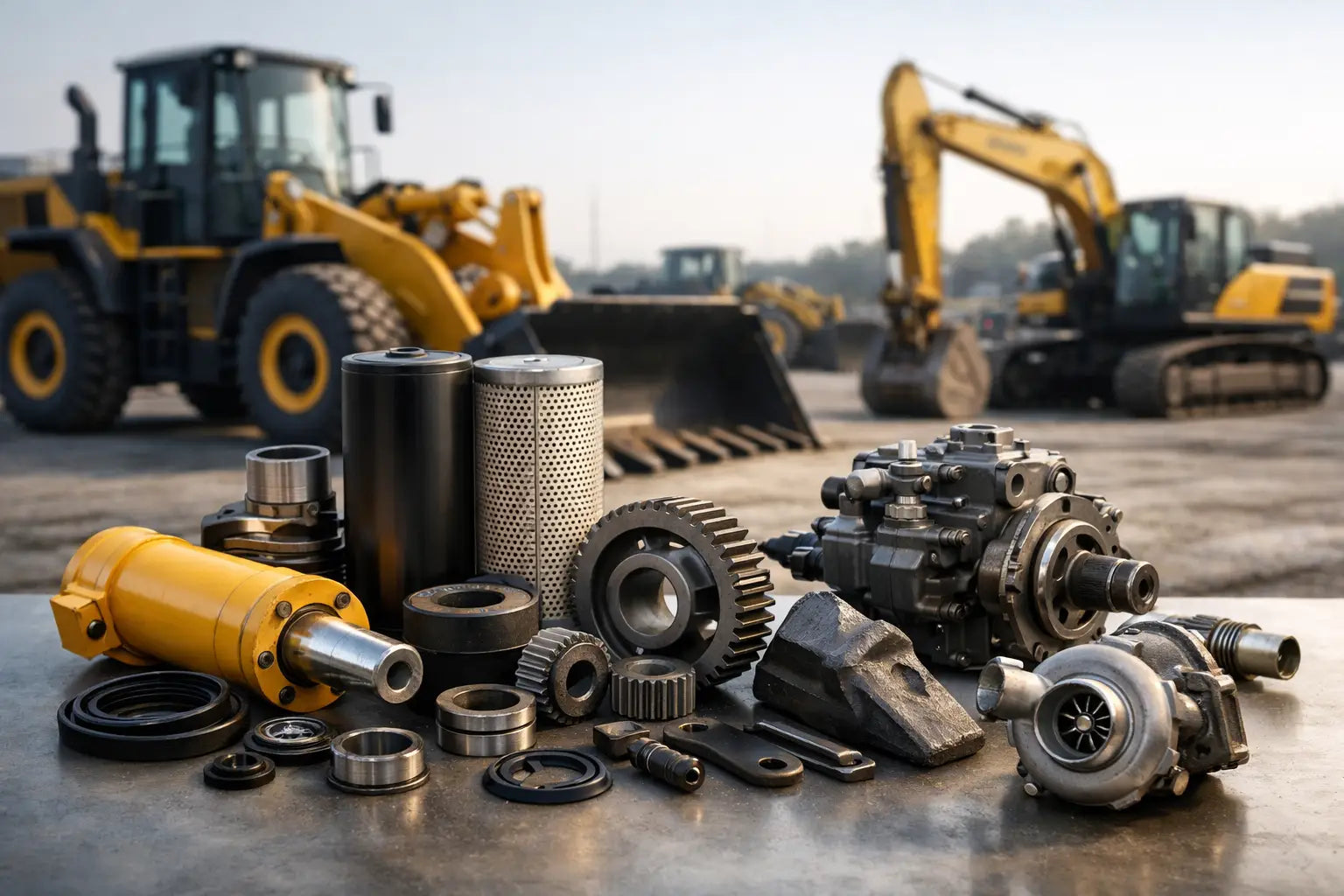
A wheel loader with a leaking tilt cylinder or an excavator parked for a failed travel seal does not need a broad parts search. It needs the correct LiuGong spare parts, identified accurately and dispatched without delay. For maintenance teams, repair shops, and equipment owners, the cost of a wrong kit is more than the item price. It is extra labor, lost machine hours, and a repair bay tied up longer than planned.
The practical approach is to match parts from the machine outward: confirm the model, locate the component, verify the OEM number where available, and check dimensions before ordering. This matters most with hydraulic seals and repair kits, where two similar-looking components may have different rod diameters, bore sizes, groove profiles, or material requirements.
Start With the Machine and Component
LiuGong equipment is used across earthmoving, material handling, mining, construction, and agriculture. A fleet may include excavators, wheel loaders, forklifts, bulldozers, and compact equipment with parts that share broad descriptions but do not share fitment. “Boom seal kit” is useful as a starting point, but it is not enough information to buy against.
Identify the machine model and the exact repair location first. On an excavator, that may be the boom, arm, bucket, blade, or travel motor. On a wheel loader, it may be lift, tilt, steering, or bucket linkage. On a forklift, mast lift, tilt, side-shift, and steering cylinders each require separate confirmation.
Machine serial number is particularly valuable when a model has production changes. Manufacturers may revise cylinder designs, piston assemblies, seal arrangements, or part numbers during a model run. If the equipment plate is readable, record the full serial number before starting the parts request. If it is not, collect the existing part number and accurate measurements from the removed component.
Why Cylinder Position Matters
Hydraulic cylinder kits are commonly described by position because that position determines the cylinder configuration. A boom cylinder and a bucket cylinder can use different rod seals, wear rings, piston seals, and wipers even when installed on the same machine. Ordering by machine model alone leaves too much room for error.
For a reliable match, provide the cylinder location together with the machine model and any number stamped on the cylinder or seal. If the old seal kit is already removed, note the rod diameter, bore diameter, seal groove dimensions, and individual seal cross-sections. Clear measurements give the parts team a workable basis for comparison when an OEM number cannot be confirmed.
How to Verify LiuGong Spare Parts Before Ordering
OEM part numbers remain the fastest way to identify a replacement. They reduce interpretation and help distinguish between close variants. But part numbers can be superseded, copied incorrectly from old records, or associated with a different serial range. Verification should combine the number with the application.
Use this order of checks when sourcing a part:
1. Confirm the equipment brand, model, and serial number or production range.
2. Identify the component and its installed position, such as BOOM KIT, BUCKET KIT, LIFT CYLINDER, or OIL SEAL.
3. Cross-check the OEM number against the component application.
4. Compare critical dimensions when replacing seals, bearings, bushings, or other wear parts.
5. Review photographs, seal profile, and material where a dimensional match alone is not sufficient.
This process is especially useful for seals. A seal may match the nominal diameter but still fail to fit the housing correctly because of lip design, height, groove width, or pressure capability. The wrong choice can cause immediate leakage, rapid wear, or damage during installation.
Match the Seal Type, Not Just the Size
Hydraulic systems use a combination of sealing and guiding elements. A typical cylinder repair may include a rod seal, buffer seal, wiper, piston seal, O-rings, backup rings, and wear rings. Each part has a specific job. The rod seal retains fluid, the wiper excludes dirt, and wear rings prevent metal-to-metal contact under side load.
Material selection also depends on service conditions. Nitrile is widely used for mineral-oil hydraulic systems. Polyurethane is common where abrasion resistance and pressure performance are needed. PTFE-based elements can suit low-friction or demanding dynamic applications, while FKM may be necessary where temperature or fluid compatibility requires it. There is no single “best” seal material for every LiuGong application.
A machine operating in clean warehouse conditions has different exposure from one working in wet quarry fines or demolition dust. Likewise, a cylinder with scoring, excessive side load, or a damaged gland will not be fixed permanently by a new seal kit alone. Inspect the rod, bore, piston, gland, and retaining hardware before installation. Replace damaged mechanical components before they destroy the new seals.
Common LiuGong Parts That Demand Careful Fitment
Seals receive attention because leaks stop work quickly, but they are only one part of the maintenance picture. Repair teams often source OIL SEALS for hubs, axles, transmissions, swing drives, and travel motors; bearings for rotating assemblies; bushings and pins for linkage wear; and machine-specific cylinder kits for planned or urgent repairs.
Oil seals deserve the same level of verification as hydraulic seals. Shaft size, housing bore, width, lip arrangement, spring configuration, and fluid exposure all affect fitment. A double-lip seal may offer better contamination exclusion in a dirty environment, but it must still suit the available housing depth and shaft condition.
Bearings also require more than a machine-model reference. Confirm the bearing number, dimensions, clearance specification, sealing arrangement, and load application. A bearing that fits physically but has the wrong internal clearance or seal type can shorten service life under heat, shock load, or contamination.
For mechanical wear parts, inspect mating surfaces and measure wear before placing the order. Replacing a pin without checking the corresponding bushing, or fitting a new bushing into an ovalized bore, can create repeat work. Parts procurement and inspection should happen together, not as separate jobs.
Reduce Downtime With Better Parts Information
Fast dispatch only helps when the order is right. The best time to collect fitment information is while the machine is still assembled or during teardown, before the old parts are discarded. Take clear photos of markings, the installed location, and the removed seal profile. Keep old components grouped by cylinder or assembly so parts from separate locations do not get mixed.
For fleet maintenance, build a simple record for each machine: model, serial number, commonly used OEM numbers, cylinder sizes, past repair history, and approved replacement options. This helps technicians and buyers avoid repeating the same identification work during the next failure. It also supports sensible stockholding for high-use items such as common seal kits, wipers, O-rings, and hub seals.
There is a balance to strike. Holding every possible part consumes cash and shelf space. Holding no critical repair stock exposes the operation to avoidable delays. The right inventory depends on machine count, utilization, lead time, failure history, and the cost of downtime. High-hour machines and equipment supporting critical contracts usually justify a deeper on-hand parts position.
When OEM Numbers Are Missing
Older machines, field repairs, and previously rebuilt cylinders often arrive without readable identification. In those cases, dimensional matching is the practical path forward. Measure with calibrated calipers where possible, and use the actual groove dimensions rather than relying only on the worn seal’s outside dimensions.
Provide the inside diameter, outside diameter, height or width, and the seal’s cross-sectional profile. For a rod seal, this normally means rod diameter, gland bore, groove width, and groove depth. For a piston seal, confirm piston diameter and groove dimensions. If the cylinder is available, photographs of the gland and piston assembly can help distinguish designs that use similar measurements.
MXPseal supports this type of parts identification with machine-specific seal kits and replacement components, backed by a broad ready-stock range for urgent maintenance requirements. The more complete the technical information, the faster a correct match can be confirmed and dispatched.
Installation Still Determines Service Life
Correct LiuGong spare parts can fail early if installation is rushed. Cleanliness is essential. Hydraulic contamination can damage fresh sealing lips, score mating surfaces, and circulate through the system after the repair. Clean the work area, flush contamination where needed, and use compatible assembly lubricant.
Do not force seals over sharp threads, ports, or edges without protection. Use installation sleeves or tape where appropriate, orient lip seals correctly, and confirm that backup rings and wear rings sit in their intended grooves. After assembly, test the cylinder or component at controlled pressure and inspect for leaks before returning the machine to full duty.
A good repair begins with the right part number or measurements, but it earns its value when the machine returns to work without a second teardown. Keep the removed part, the verified dimensions, and the final part number in the machine record. That small step makes the next LiuGong repair faster, more predictable, and easier to schedule.