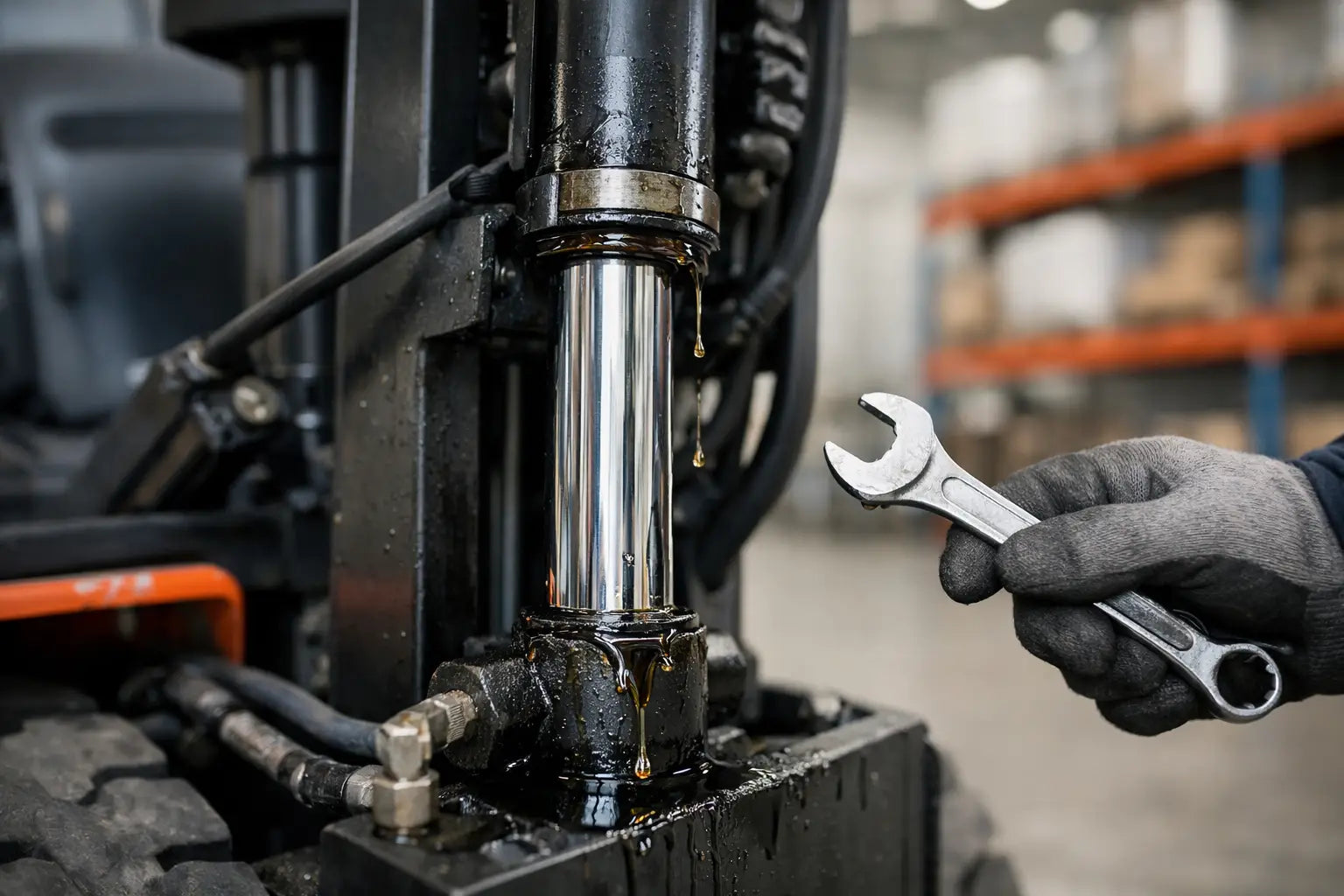
A wet mast rail, oil under a steer axle, or a lift cylinder that will not hold height is not a minor housekeeping issue. When forklift seals leaking becomes the maintenance report, the immediate job is to identify the fluid, locate the true leak path, and order parts by verified dimensions or OEM number. Replacing the first seal that looks suspicious can turn a one-shift repair into repeat downtime.
Forklifts work through constant cycling, side loading, vibration, temperature changes, and contamination. A seal may be the failed component, but the root cause can be a scored rod, worn bushing, blocked breather, incorrect oil, or a damaged mating surface. The repair has to address both.
Start by Identifying the Fluid and Leak Location
Clean the affected area before making a diagnosis. Hydraulic oil migrates along cylinder rods, mast channels, hoses, and chassis members, so the lowest wet point is not always the source. Degrease the area, run the truck through its normal lift, tilt, and side-shift functions, then inspect again under good lighting.
The fluid type helps narrow the system. Hydraulic oil usually appears around lift, tilt, side-shift, and reach cylinders. Gear oil at a drive wheel or axle housing points toward a hub, axle, or wheel-end oil seal. Oil at a transmission bellhousing, differential, or driveshaft connection may indicate an input, output, or pinion seal. On internal-combustion forklifts, engine oil, coolant, fuel, and hydraulic oil can be present in the same general area, so do not assume every leak is hydraulic.
| Leak area | Likely failure point | What to check before ordering |
|---|---|---|
| Cylinder rod end | Rod seal, wiper seal, worn rod surface | Rod pitting, chrome damage, side play, gland condition |
| Cylinder base or port | O-ring, backup ring, fitting seal | Port threads, fitting type, bore damage, torque |
| Mast lift cylinder | Piston seal or internal cylinder wear | Drift under load, bypassing, bore scoring |
| Tilt cylinder | Rod seal, piston seal, pin seal wear | Rod alignment, mounting bushings, cylinder movement |
| Drive wheel or axle end | Hub or axle oil seal | Bearing condition, seal land, axle play, lubricant level |
| Transmission or differential | Input, output, or pinion oil seal | Shaft groove, breather condition, bearing play |
A rod that is oily only after several lift cycles commonly indicates an external rod-seal or wiper failure. A cylinder that stays dry outside but allows the carriage or mast to drift may have an internal piston-seal bypass. These are different repairs. External leakage creates a visible mess and fluid loss; internal bypass can reduce holding performance without leaving oil on the floor.
Why Forklift Seals Start Leaking
Age and normal wear are part of the picture, but forklift seal failures are often accelerated by operating conditions. Dust and metal fines collect around exposed cylinder rods. When the wiper is worn or damaged, contamination reaches the rod seal and can score the seal lip during every stroke. In freezer applications, seal material can harden and lose flexibility. In high-heat or chemical environments, incompatible elastomers may swell, crack, or degrade early.
Rod condition matters as much as seal condition. Rust pits, damaged chrome, and sharp burrs cut a new seal quickly. Run a clean fingernail across the rod in the working stroke area. If it catches on a defect, a seal kit alone is unlikely to provide a durable repair. Minor isolated damage may be repairable depending on location and severity, but deep pitting, peeling chrome, or a bent rod generally calls for rod replacement or professional reconditioning.
Misalignment is another common cause. Worn mast rollers, loose cylinder pins, oval pin bores, or failed bushings can side-load the rod and gland. The result is uneven lip wear and repeated leakage from the same cylinder. If a new rod seal fails after a short service interval, inspect alignment before fitting another kit.
Pressure problems also deserve attention. A relief valve set too high, a blocked return path, or thermal expansion in a trapped circuit can force seals beyond their design limits. This is less common than physical wear, but it should be considered when several components begin leaking or a newly rebuilt cylinder fails immediately.
Inspect the Whole Cylinder, Not Just the Wet Seal
Depressurize the hydraulic system and support the mast or attachment mechanically before disconnecting any component. Never rely on hydraulic pressure to hold a raised load, carriage, or mast section during inspection. Follow the truck manufacturer’s lockout procedures and keep hands clear of possible injection leaks.
Once the cylinder is removed, inspect the gland threads, gland O-ring area, rod, piston, bore, wear rings, and port seals. A complete cylinder seal kit is usually the efficient choice when the cylinder is already open because it replaces the working seals, static seals, and wear components that age together. Replacing only the rod seal can save a small amount on parts, but it may leave a hardened gland O-ring, worn piston seal, or flattened backup ring in service.
For a hydraulic cylinder, verify whether the kit includes a rod seal, wiper, piston seal, wear rings, O-rings, and backup rings. The exact configuration depends on the cylinder design. A lift cylinder may use a different piston arrangement from a tilt or side-shift cylinder even on the same forklift model. Do not assume cylinder location alone is enough for correct fitment.
Match Replacement Seals by Part Number and Dimensions
The fastest route to an accurate order is the equipment model, serial number, cylinder position, and OEM cylinder or seal-kit part number. Forklift manufacturers can change cylinder suppliers during a production run, and aftermarket mast assemblies may differ from the original specification. Model-only identification is useful, but it is not final verification.
If the part number is unavailable, measure the removed components and the mating hardware. For rod seals and wipers, confirm rod diameter, gland bore diameter, groove width, and groove depth. For piston seals, confirm piston diameter, groove dimensions, and seal profile. For rotary oil seals, verify shaft diameter, housing bore, width, lip arrangement, spring type, and rotation or pressure requirements where applicable.
Material selection is not a detail to skip. Nitrile is widely used with standard mineral hydraulic oils and many gear-oil applications. Polyurethane is commonly selected for abrasion-resistant hydraulic rod and piston sealing. Fluorocarbon may be needed for higher temperature or chemical exposure, while low-temperature applications can require a compound designed to remain flexible in cold conditions. The correct profile in the wrong material can still fail early.
When comparing replacement parts, check the profile as well as the nominal size. A U-cup, compact seal, buffer seal, chevron packing, and energized lip seal can share similar dimensions while serving different pressure, movement, and installation requirements. Exact cross-section and orientation matter.
Installation Errors That Cause Repeat Leaks
A good replacement kit can be damaged before the forklift returns to work. Cleanliness is essential. Fine debris inside a cylinder can cut a seal lip, while dirty assembly lubricant can contaminate the hydraulic system. Use compatible clean hydraulic fluid or specified assembly lubricant, and protect seal lips from threads, keyways, and sharp edges with proper installation tools or sleeves.
Install seals in the correct direction. In a pressure-energized hydraulic seal, the open side generally faces the pressure source, but always follow the specific seal design and cylinder configuration. For rotary oil seals, the spring side normally faces the fluid being retained. Reversing a seal may allow it to install easily, then leak immediately under pressure or rotation.
After assembly, cycle the function slowly without a load where safe to do so. Check for external leakage, unusual movement, and trapped air. Then verify fluid level after the system has stabilized. Do not return a forklift to service with a small "watch it" leak around lifting or steering components. Fluid loss affects performance, creates slip hazards, and can lead to larger component damage.
When a Seal Replacement Is Not Enough
A leaking wheel-end seal combined with bearing play requires bearing inspection and likely replacement. A cylinder with a scored bore may need honing, re-tubing, or replacement. A transmission seal leaking around a grooved shaft may need a repair sleeve or shaft replacement. The lower-cost seal-only repair is worthwhile only when the sealing surfaces and supporting components are within serviceable condition.
For urgent repairs, prepare the part request with the forklift make, model, serial range, component location, OEM number, and measured dimensions. For a cylinder, include rod diameter, bore diameter, and whether it is a lift, tilt, side-shift, or reach function. That information reduces fitment delays and makes it easier to source a ready-stock seal kit, oil seal, bearing, or associated replacement part from a specialist supplier such as MXPseal.
The best repair is the one that stops the leak once, protects the machine’s working components, and gets the truck back onto the schedule without another parts order next week.