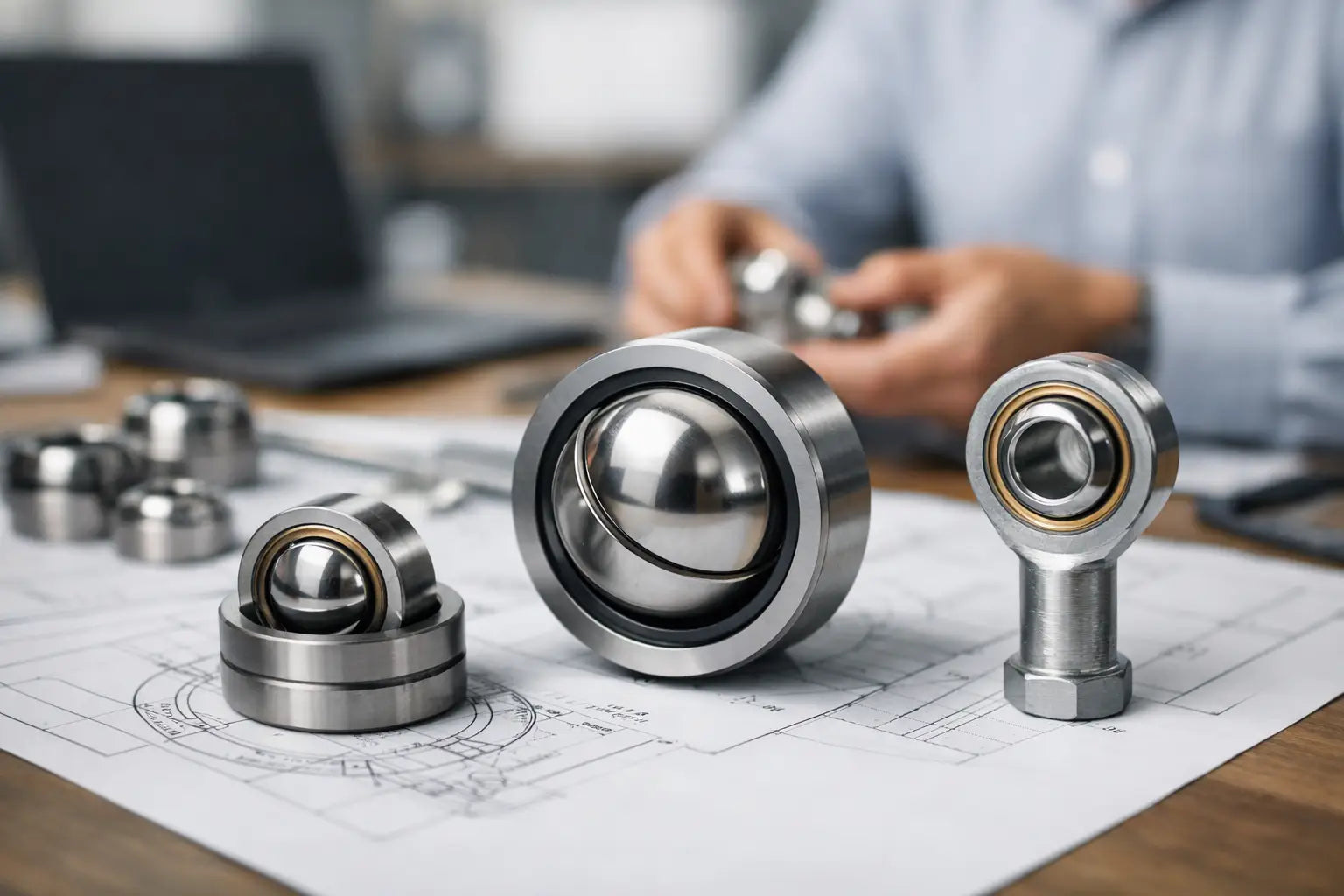
A failed spherical bearing rarely stays a small repair. Excessive play at a boom linkage, steering joint, loader pivot, or cylinder mounting point can accelerate pin wear, affect machine control, and turn a planned service into a longer shutdown. The right spherical bearing supplier helps prevent that outcome by supplying the correct bearing type, dimensions, clearance, and sealing arrangement before the machine is stripped down.
For heavy-equipment repair teams, the lowest unit price is only one part of the purchase decision. Stock availability, part-number verification, dispatch time, and confidence in material quality usually matter more when a machine is scheduled for work the next morning.
What a Spherical Bearing Supplier Must Verify
“Spherical bearing” can describe several products with very different applications. In earthmoving and industrial equipment, it commonly refers to a spherical plain bearing used in oscillating or slow-rotating pivot points. It may also refer to a spherical roller bearing used in shafts and housings where misalignment, radial load, and rotational speed are factors. These parts are not interchangeable.
A supplier should first establish the bearing category rather than relying on a general description such as “joint bearing” or “pivot bearing.” For a spherical plain bearing, confirm whether the application requires a maintenance-free PTFE-lined bearing, a grease-lubricated steel-on-steel type, a sealed version, or a corrosion-resistant construction. For a spherical roller bearing, confirm the bore, outside diameter, width, internal clearance, cage design, and any taper or adapter sleeve requirement.
Machine position matters as much as the bearing dimensions. A bearing at a bucket linkage may operate in mud, abrasive dust, and frequent shock loading. A cylinder eye bearing may see high static loads with limited movement. A steering articulation bearing can be exposed to repeated oscillation and contamination. Two bearings with similar measurements can have different internal materials, lubrication needs, or seal configurations because their working conditions are different.
Exact identification starts with the OEM part number whenever it is available. If the number is worn, missing, or does not cross clearly, measure the bore ID, outside diameter, and width with suitable tools. Also record the machine brand, model, serial range where applicable, component location, and whether the original bearing has seals, lubrication holes, or a split outer ring. Good fitment information reduces the risk of receiving a bearing that presses into the housing but fails early in service.
Stock Is More Than a Website Status
For maintenance buyers, “available” should mean the part is physically ready to dispatch, not that it can be sourced after an order is placed. This distinction becomes critical when a technician has already removed a pin, opened a linkage, or stripped a hydraulic cylinder.
A dependable supplier maintains stock across common sizes and high-turning machine applications, while also carrying model-specific replacement parts that are not easily found at a general bearing counter. The value is not simply a larger catalog. It is the ability to source a bearing alongside related repair items such as seals, O-rings, bushings, pin seals, retaining rings, or a complete cylinder seal kit from one order.
Ask practical inventory questions before placing an urgent order. Is the exact part in stock now? Is the displayed quantity current? Can the supplier confirm the dispatch cutoff? Is the item held locally or transferred from another warehouse? These questions are direct, but they prevent false expectations and unnecessary downtime.
MXPseal supports this type of purchasing with ready-stock industrial parts and machine-specific repair components, helping workshops combine bearing and sealing requirements when equipment is already down for service.
Fitment Errors Usually Start Before Installation
A bearing can be genuine, correctly manufactured, and still be wrong for the repair. Most costly errors begin with incomplete identification or an assumed interchange.
One common issue is confusing a spherical plain bearing with a rod end bearing. A rod end includes a threaded shank and housing, while a spherical plain bearing is normally pressed into an eye, yoke, or housing. Another is ordering an open bearing for a contaminated application that originally used integral seals. The open bearing may fit, but its service life can be much shorter if the machine operates in wet aggregate, demolition debris, or fine quarry dust.
Internal clearance also deserves attention for rolling bearings. Clearance is not a cosmetic catalog detail. Shaft fit, housing fit, operating temperature, and load can reduce working clearance after installation. A bearing with the wrong clearance class may run hot, produce noise, or fail prematurely. When replacing a spherical roller bearing, match the original designation fully, including suffixes, unless a qualified engineering decision supports a change.
For equipment-specific repairs, verify against more than one reference when possible. Compare the original marking, machine parts book, dimensions, application location, and supplier cross-reference. If any detail conflicts, stop and resolve it before ordering. A fast dispatch is only useful when the part is correct.
Quality Depends on Application, Not Just Brand Name
Recognized bearing brands are often the right choice for critical, high-load, or continuous-duty applications. They may offer documented specifications, consistent manufacturing control, and established cross-reference data. That said, branded packaging alone does not solve a fitment or installation problem.
The right quality level depends on the machine’s duty cycle, operating environment, expected service interval, and cost of downtime. A rental fleet operating daily under high load has different requirements from a low-hour agricultural attachment. A sealed maintenance-free bearing can reduce grease-service demands, but it may not suit an application designed around regular lubrication. A greaseable steel-on-steel bearing may tolerate severe shock loads well, provided grease reaches the bearing and contamination is controlled.
Procurement teams should also consider traceability. For recurring maintenance programs, retain the supplier invoice, manufacturer designation, dimensions, and machine application in the service record. This creates a usable history if a bearing wears unusually quickly or if several machines show the same failure pattern. It also prevents a workshop from repeatedly ordering a vague description that changes from one purchase to the next.
Evaluate the Supplier’s Technical Response
A supplier does not need to redesign the machine to be useful. It does need to ask enough questions to protect the order from an obvious mismatch. A good response is specific: it confirms the bearing designation, dimensions, application, stock position, and expected dispatch timing. It does not promise compatibility based only on a photograph or a partial machine description.
Before approving a new supplier, assess how it handles these four areas:
- Part-number and dimensional verification, including suffixes and sealing details.
- Clear stock status and realistic dispatch commitments.
- Product information that identifies brand, bearing type, and application rather than using generic labels.
- A workable returns process for unused parts ordered in error.
Installation Conditions Affect Bearing Life
Even the correct bearing can fail early if the surrounding components are worn. Inspect the pin or shaft for scoring, corrosion, out-of-round wear, and incorrect surface finish. Check the housing bore for damage, looseness, or distortion. If a bearing is loose in its housing, replacing only the bearing may provide a short-term result while allowing movement to continue.
Use the correct press method and apply force only through the ring being fitted. Pressing through the inner ring while installing the outer ring can damage the bearing surfaces. Avoid hammering unless the manufacturer specifically permits a controlled procedure. For sealed spherical plain bearings, make sure the seals are not cut or displaced during installation.
Lubrication should follow the bearing design and machine service schedule. Over-greasing can force contaminants past damaged seals or create pressure where it is not wanted, while under-greasing leaves metal-to-metal contact exposed. If a new bearing fails quickly, inspect the grease path, pin alignment, bore condition, load direction, and seal protection before blaming the bearing itself.
Buy for the Repair Window You Actually Have
The best purchasing method matches the urgency of the job. For planned overhaul work, verify part numbers early and stage bearings, seals, pins, and hardware before teardown. For breakdown repairs, prioritize a spherical bearing supplier that can confirm exact stock and dispatch without turning the order into a backorder search.
Keep the removed bearing until the replacement has been checked against it. Compare markings, dimensions, width, seal position, lubrication features, and contact surfaces at the bench. That five-minute check can save a second teardown, return freight, and another missed shift.
When the machine is waiting, the right bearing is not simply the one that appears first in a search result. It is the one that matches the application, arrives when promised, and gives the repaired joint a realistic service life under the work it actually performs.